
My mother has an uncanny ability to select books for my four-year-old daughter. She chooses things I would never have picked out—and they seem slightly out of left field—but somehow my kid always becomes obsessed with whatever book her grandmother has recently gifted. One of the most surprising and successful literary selections was Fanny’s Big Idea, a children’s book about Fanny Goldstein (1895–1961), the first Jewish librarian of a Boston Public Library branch and the founder of Jewish Book Week.

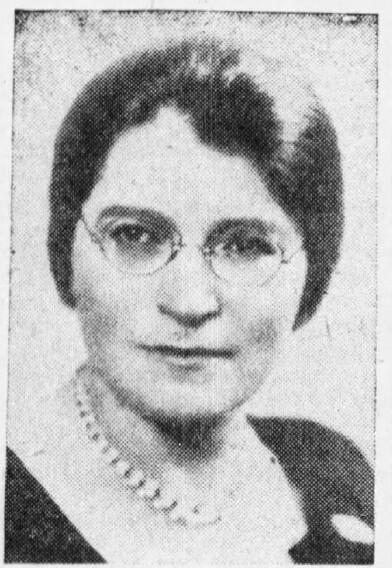
I was, therefore, thrilled to learn that Fanny, whose story I have read approximately one hundred times, met and corresponded with Isabella Stewart Gardner. This represents a kismet overlap between my museum and home life, and this blog post is a chance to share the story of an exceptional person in Boston’s history.
A Jewish Immigrant in Boston
Fanny was born in Russia in 1895. Fleeing antisemitic violence, her family immigrated to Boston’s North End neighborhood when Fanny was five. Unfortunately, after her father passed away, Fanny dropped out of formal schooling to help support her family. However, she remained hungry for educational opportunities and joined the Saturday Evening Girls Club, a reading and social group for immigrant girls founded by librarian Edith Guerrier. At the group's peak in the mid-1910s, the club supported 250 members, established a newspaper called the S.E.G. News, operated the Paul Revere Pottery, and strove to improve their members’ lives through education, economic opportunity, and independence.1
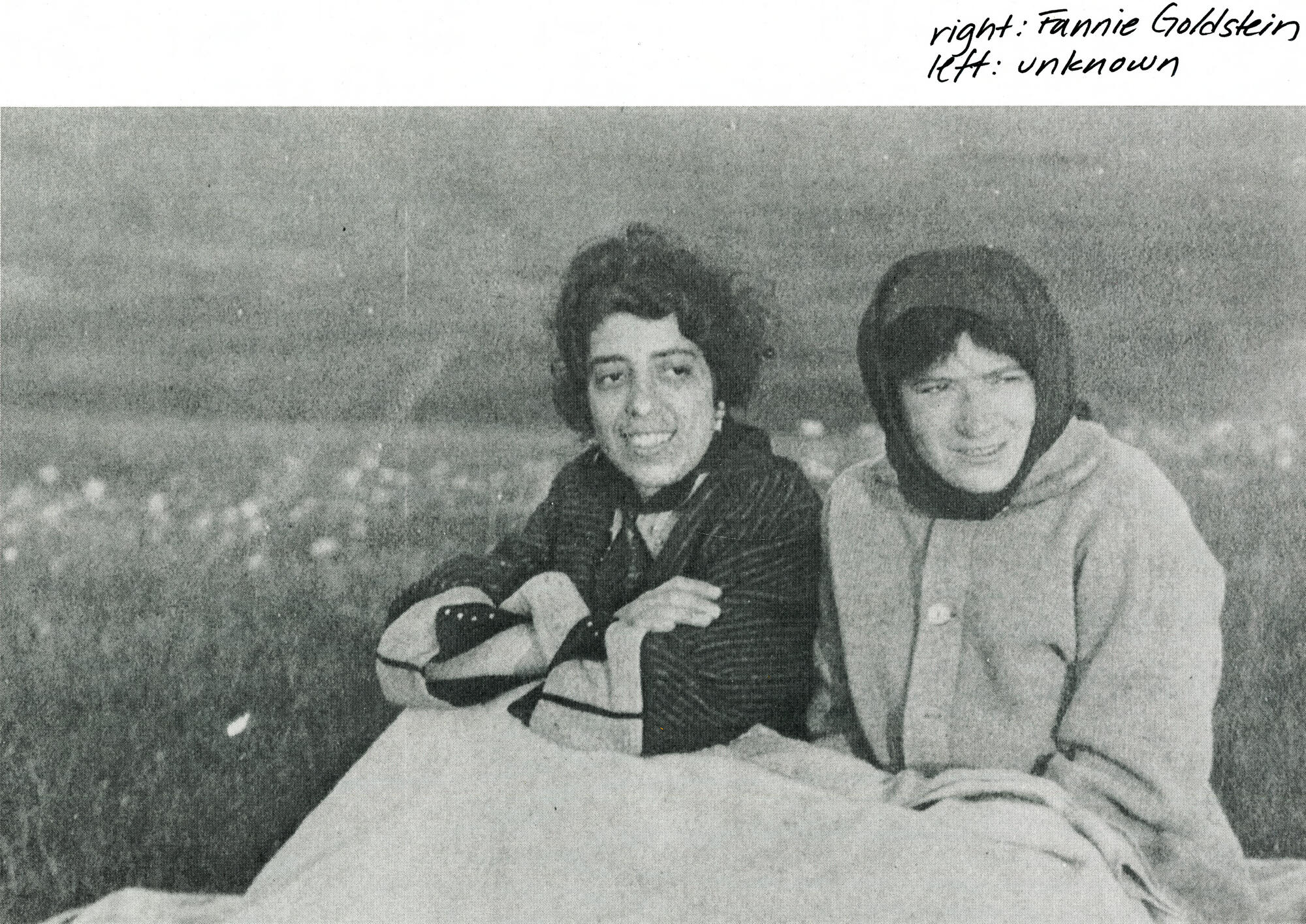
University of Massachusetts Boston, Joseph P. Healey Library (UASC-SCPHO-0167-0007-0321-0001)
Fanny Goldstein (right) and an unidentified friend at a Saturday Evening Girls Club event, about 1908–1917
Isabella’s Support of the Saturday Evening Girls Club
Fanny served as secretary of the club, and it was in this capacity that she corresponded with Isabella, who supported the organization by hosting benefit performances.
After a concert at the Gardner family Brookline estate called Green Hill in June of 1908, Fanny wrote—in lovely cursive—a note of appreciation. Fanny, who was just thirteen years old, must have made an impression. Isabella saved the letter which is preserved in the Museum’s Archives.
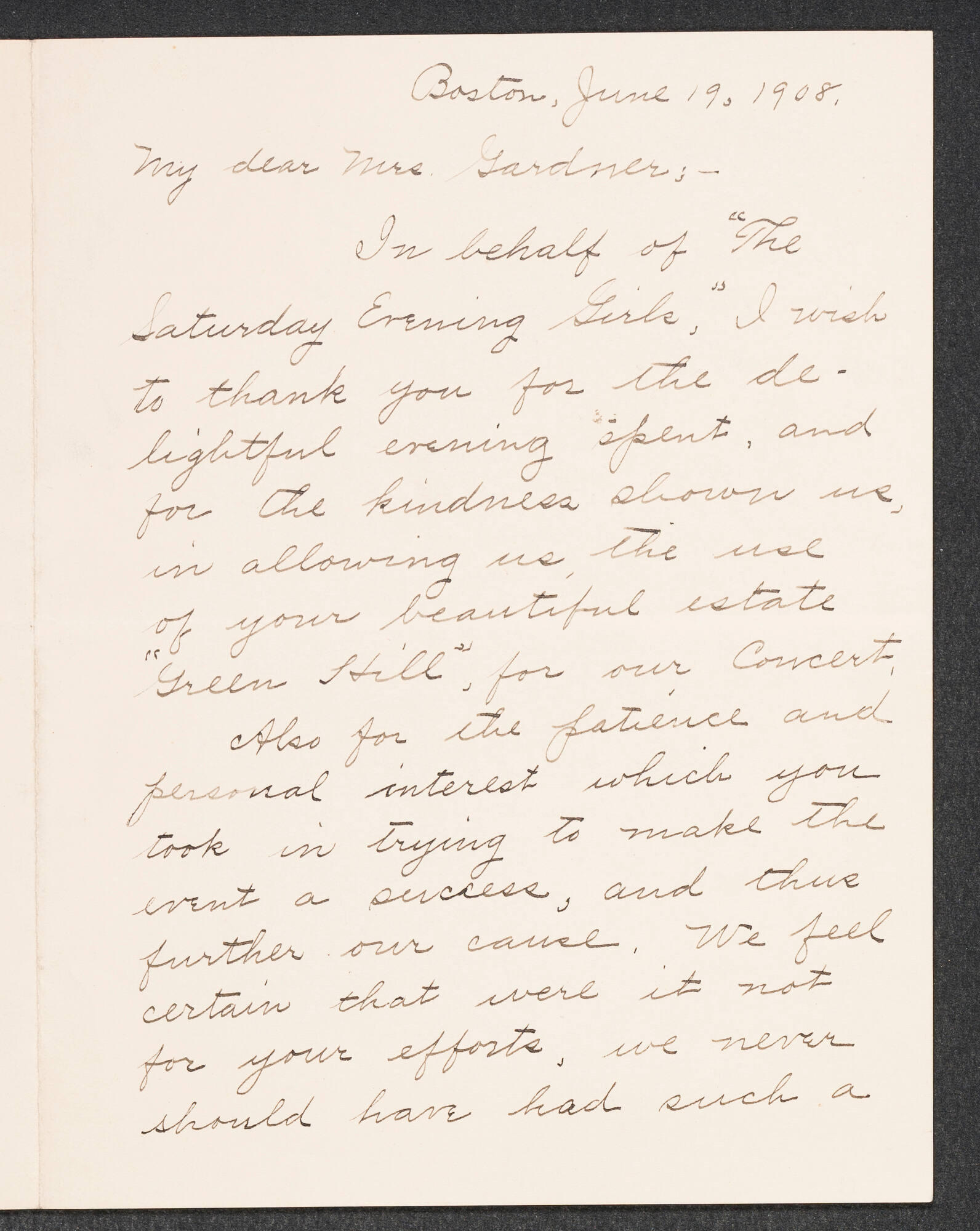
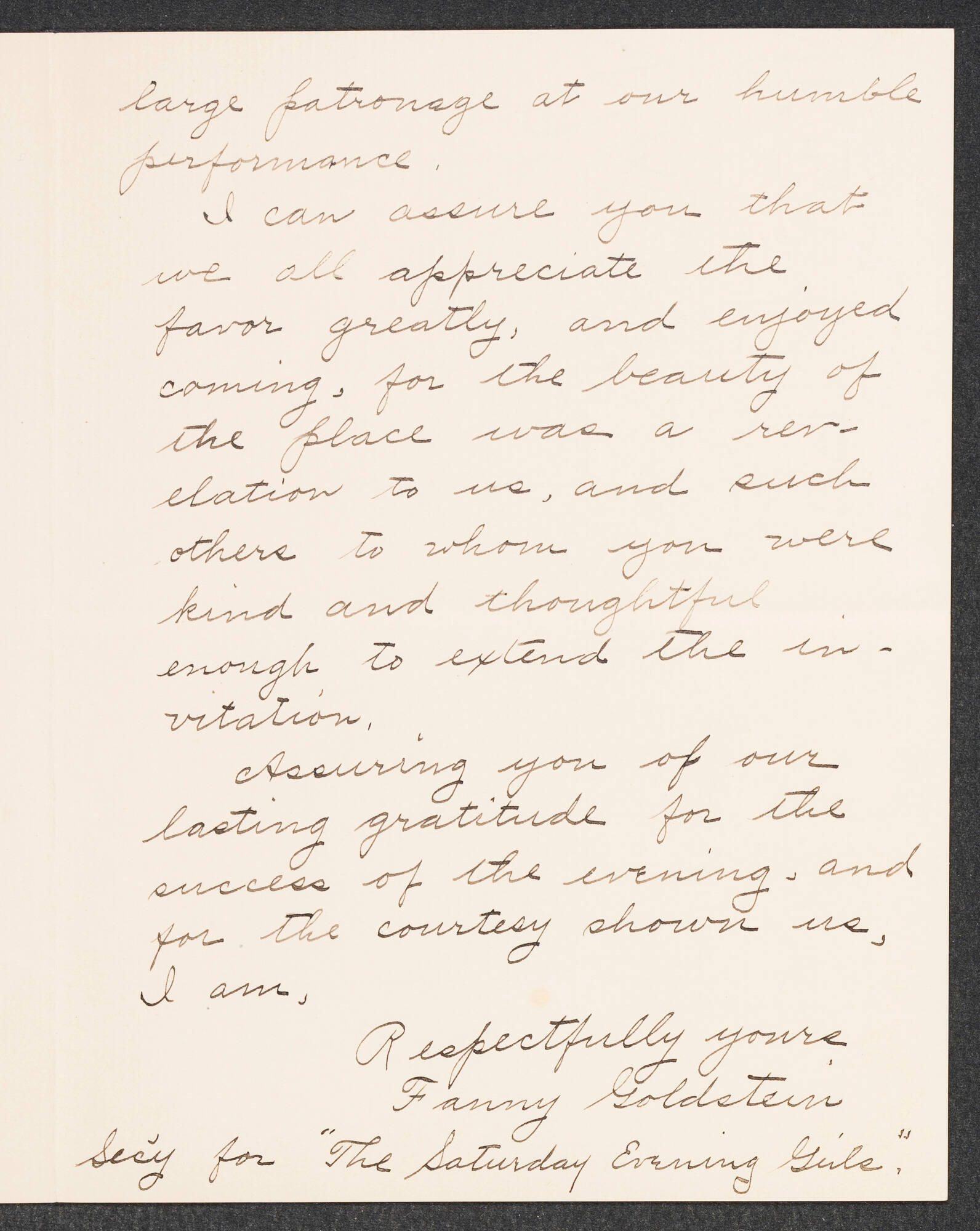
It reads:
My dear Mrs. Gardner,
On behalf of “The Saturday Evening Girls,” I wish to thank you for the delightful evening spent, and for the kindness shown in allowing us the use of your beautiful estate “Green Hill” for our concert. Also for the patience and personal interest which you took in trying to make the event a success and thus further our cause. We feel certain that if it were not for your efforts, we never should have had such a large patronage at our humble performance.
Respectfully yours,
Fanny Goldstein
Sec’y [Secretary] for “The Saturday Evening Girls”
Later, in March of 1912, Gardner welcomed the Saturday Evening Girls Club again—this time they performed William Shakespeare’s play The Merchant of Venice in the Museum’s Music Room. In their reminiscences, the women from the club recalled how Isabella “flew around behind the scenes and cautioned us…not to dare to touch the priceless tapestries.” Despite Gardner’s anxieties about protecting her art collection, the evening went well, and the crowd included many of Boston’s leading philanthropists.
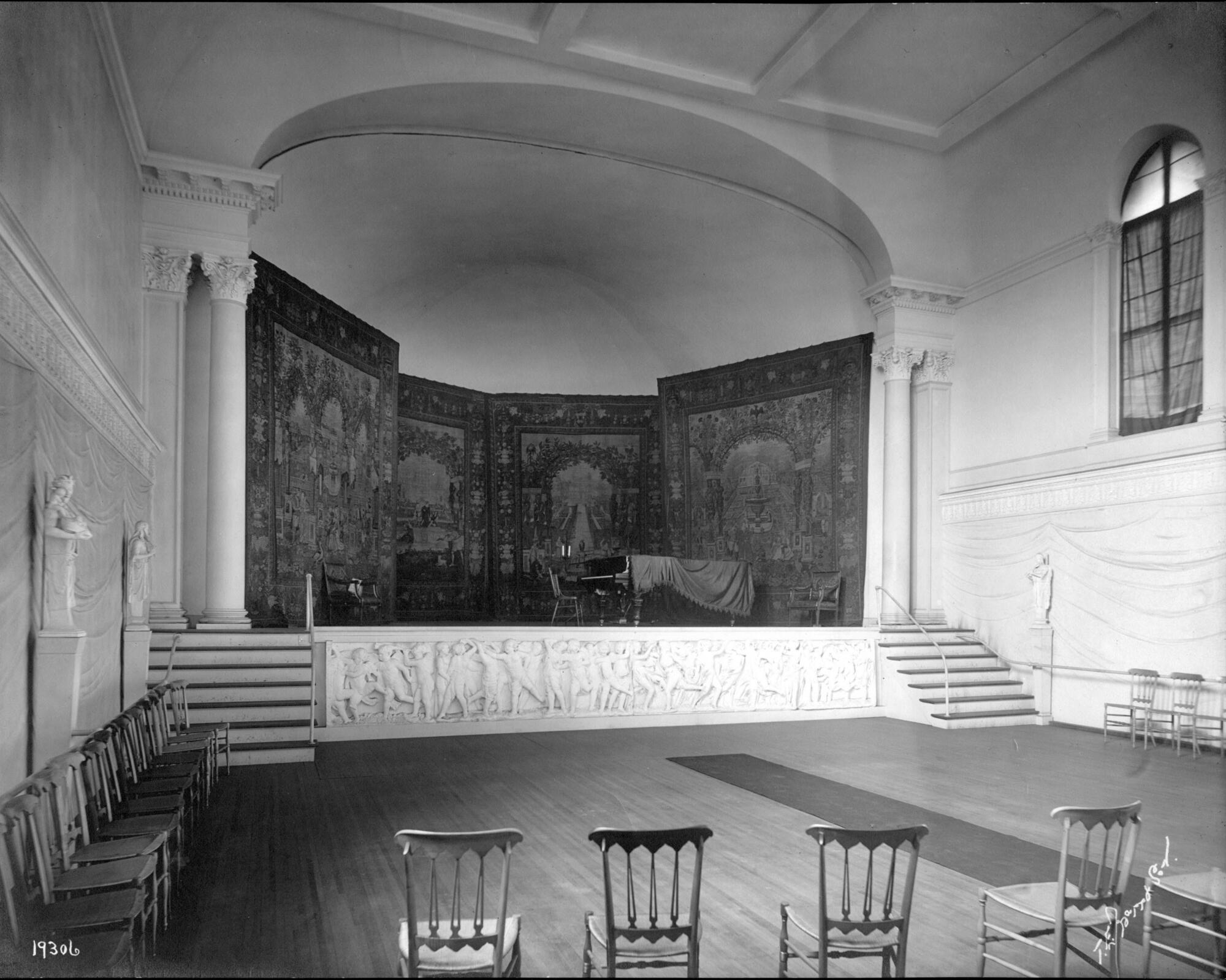
Isabella Stewart Gardner Museum, Boston (Marr 19306)
Thomas E. Marr & Son (active Boston, 1910–1942), The Music Room, 1914, where the Saturday Evening Girls Club performed William Shakespeare’s play The Merchant of Venice in 1912
As gifts for the attendees of the performance, Gardner gave out small bowls produced by Paul Revere Pottery. The workshop, established in Boston’s North End, produced fine earthenware dishes and vessels and gave members of the Saturday Evening Girls Club reliable and safe employment as potters and decorators.2 Isabella kept seven similar bowls in her apartment, and they remain in the Museum’s collection.
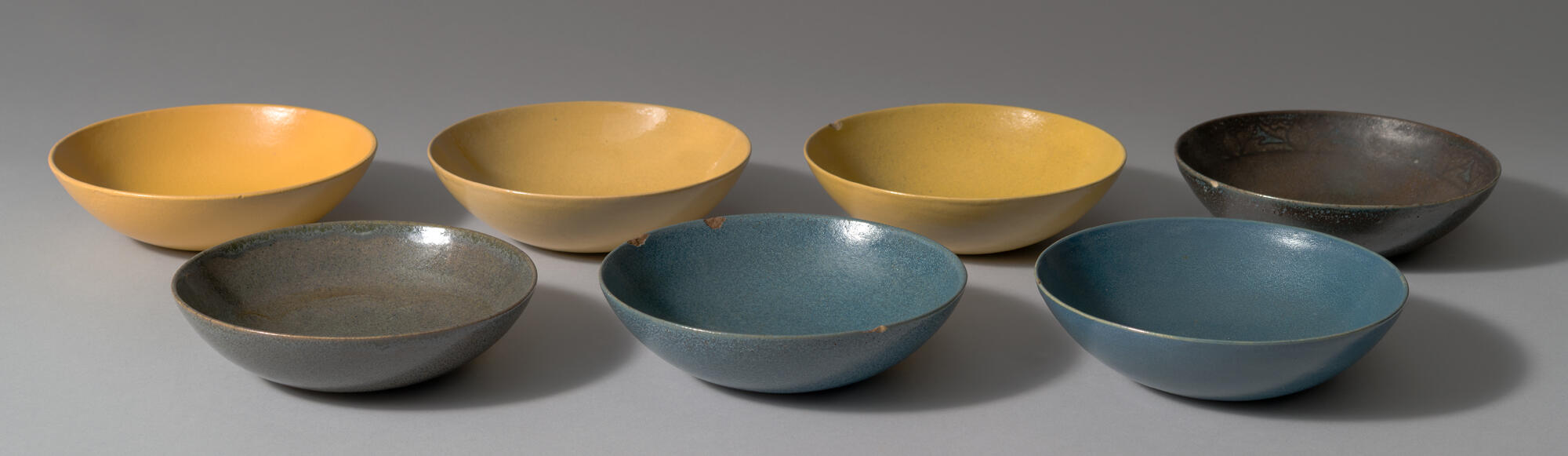
Isabella Stewart Gardner Museum, Boston (SP1925.1.121.1-7)
Paul Revere Pottery (active Boston, 1908–1942, manufacturer) and
Saturday Evening Girls Club (active Boston, 1899–1969, makers), Seven Bowls, about 1912. Glazed earthenware, diameter: 15.2 cm (6 in.) each
Though these examples are simpler than the best-known earthenware produced by the pottery—like an exceptional vase in the collection of the Metropolitan Museum of Art—the bowls are nonetheless elegant and practical with lovely colored glazes.
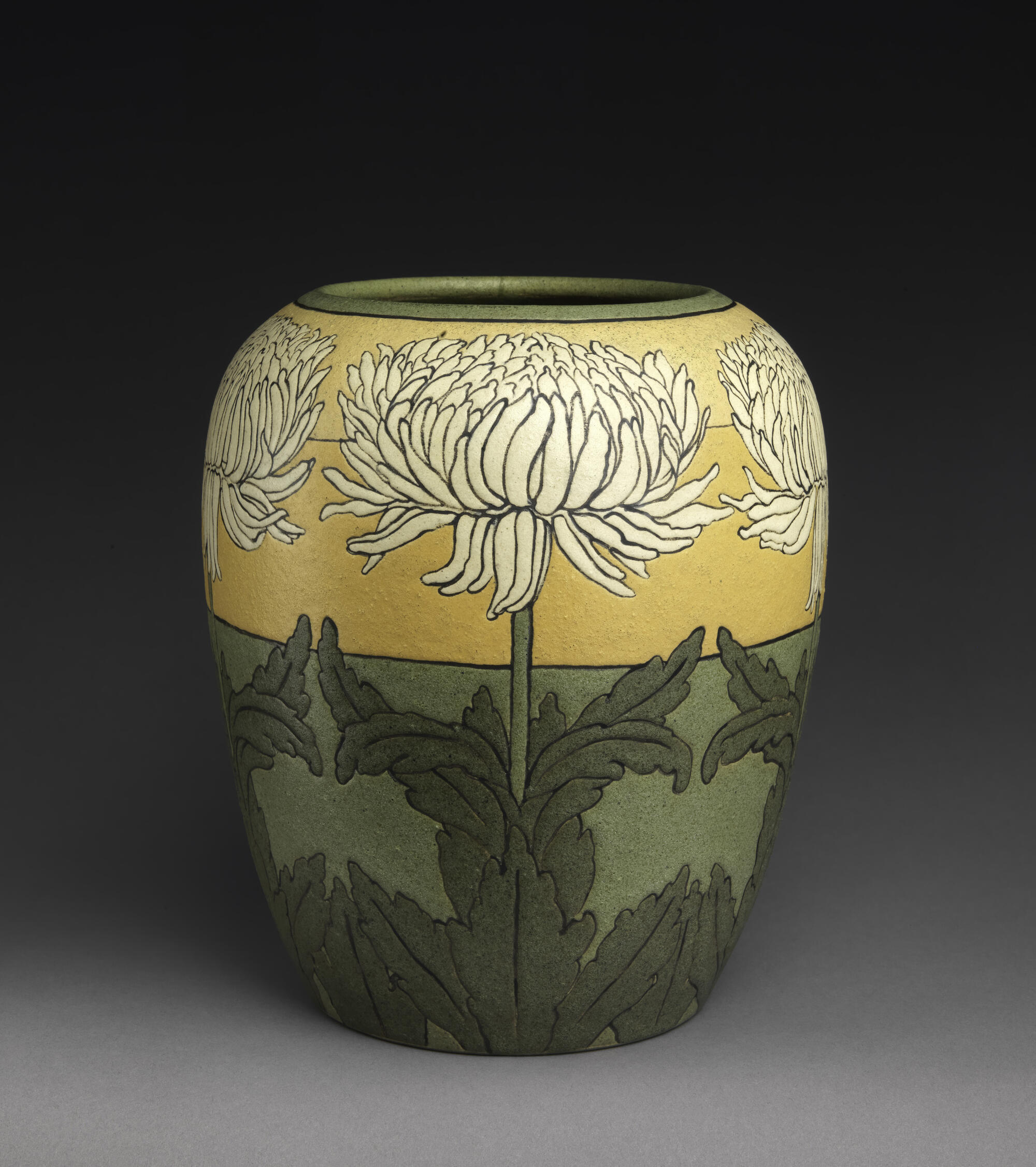
The Metropolitan Museum of Art, New York. Gift of Robert A. Ellison Jr., 2017 (2017.357.10). © The Metropolitan Museum of Art. Image source: Art Resource, NY
Paul Revere Pottery (active Boston, 1908–1942, manufacturer), Saturday Evening Girls Club (active Boston, 1899–1969, makers), Edith Brown (American, 1872–1932, designer), and Ida Goldstein (1894–1990, decorator), Vase, about 1908–15. Earthenware, 8 3/4 x 7 9/16 in. (22.2 x 19.2 cm)
Fanny, the Librarian
Fanny did not work as a potter or decorator, but she put the exceptional eloquence evident in her letter to Isabella to good use as the editor-in-chief of the Club’s newspaper. However, she had other professional aspirations, and—like the Saturday Evening Girls Club founder—she wanted to become a librarian. She became an assistant at the North End’s branch of the Boston Public Library (BPL) and took classes at Simmons College, Harvard University, and Boston University to further her education. Ultimately, she became the head of the West End branch of the BPL serving a diverse neighborhood of immigrants from around the world and migrants from around the United States.
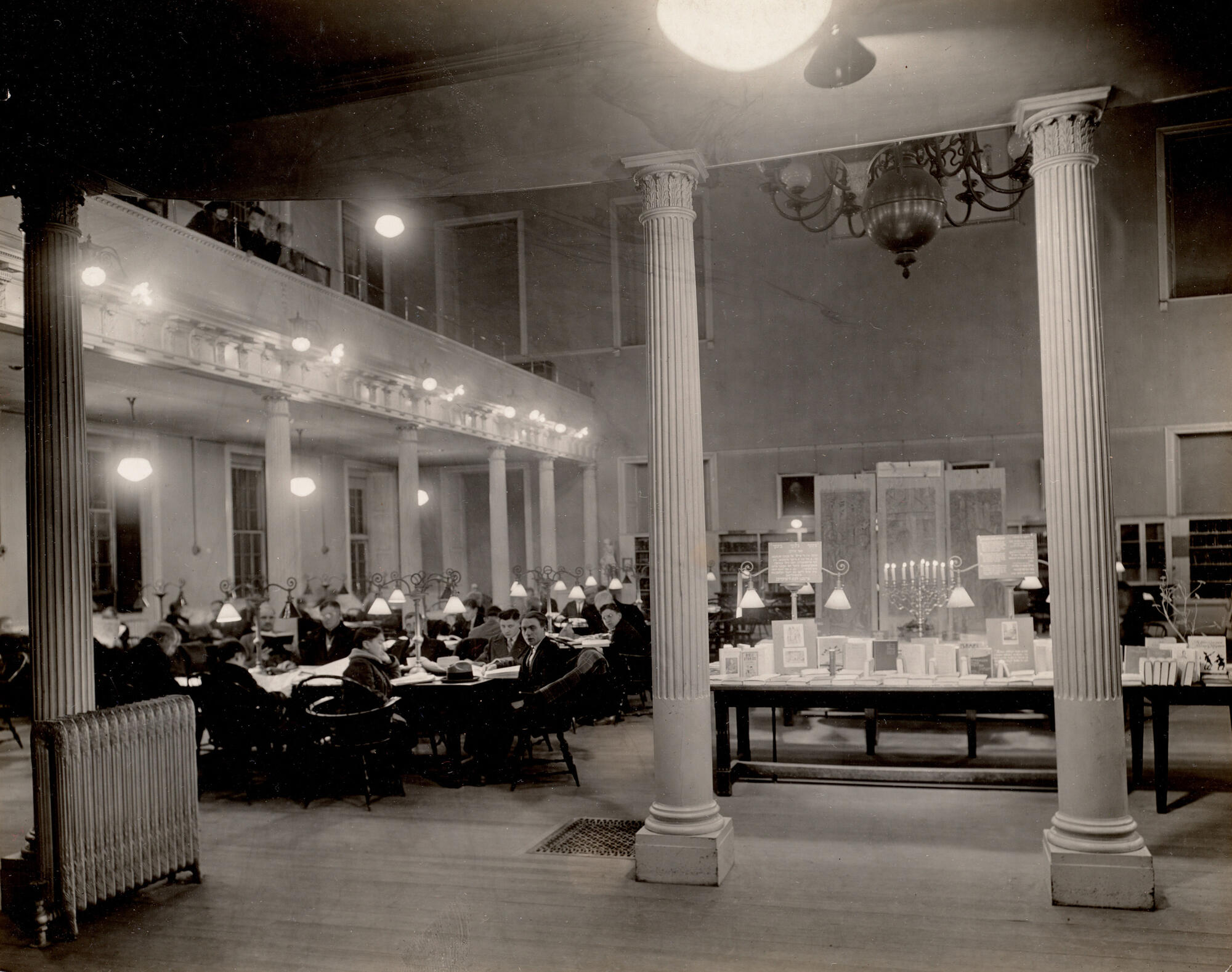
Boston Public Library, https://ark.digitalcommonwealth.org/ark:/50959/gt54m998j
The Reading Room, West End Branch of the Boston Public Library, 1896-1926. Gelatin silver print, 18.6 x 25.4 cm (7 ¾ x 10 in.)
Fanny made it a priority to feature books that connected with the cultures of the patrons she served. As part of these efforts, she founded Jewish Book Week to feature Jewish authors and books about Jewish culture. She created similar celebrations for other cultural groups living in the West End. Her goal was to use books to teach people of different backgrounds both about their own history and about each other.
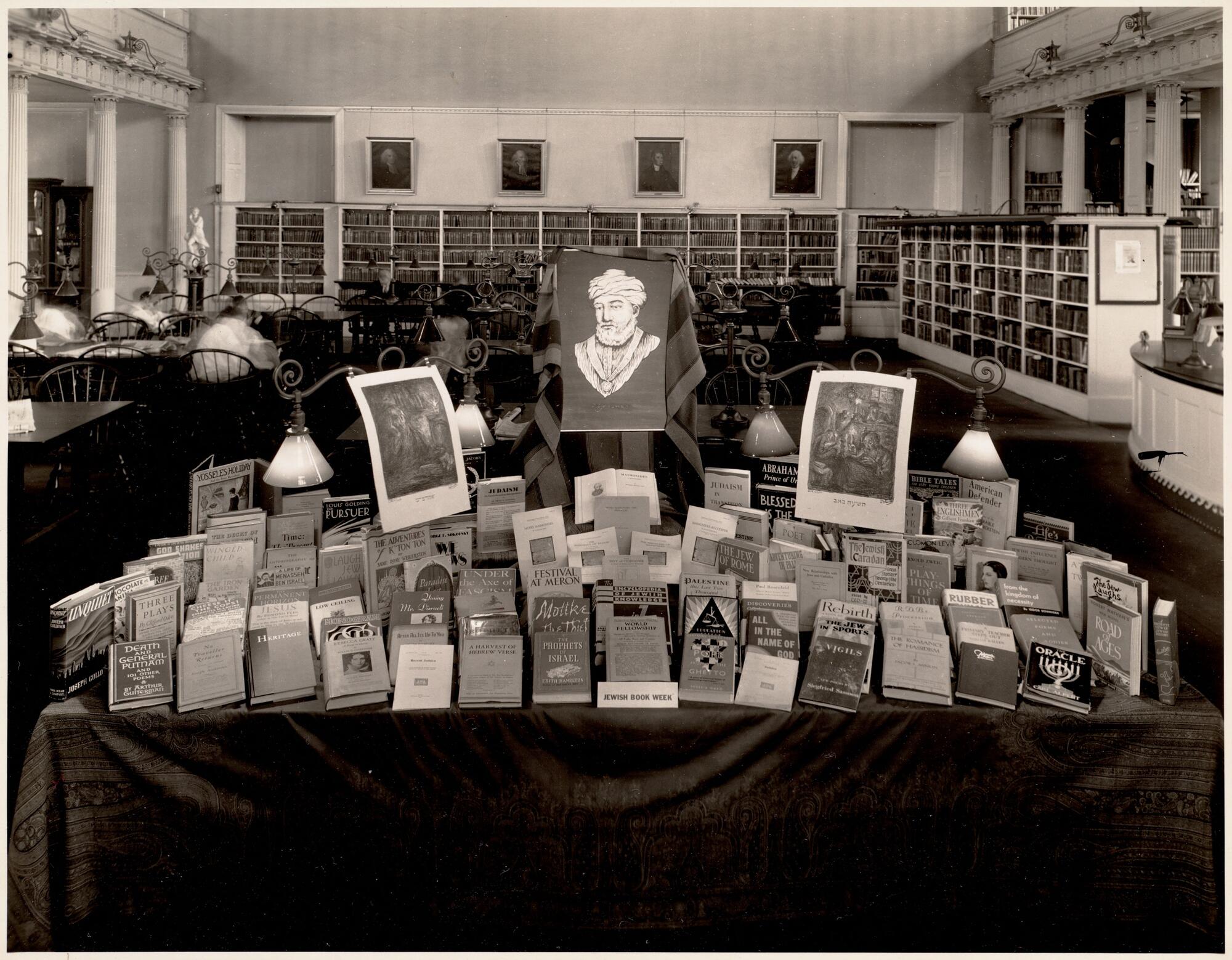
Boston Public Library, https://ark.digitalcommonwealth.org/ark:/50959/gt54m990b
A display for Jewish Book Week arranged by Fanny Goldstein at the West End Branch of the Boston Public Library, May 1929. Gelatin silver print, 18.6 x 25.4 cm (7 ¾ x 10 in.)
Isabella may have seen a spark of something special in the letter she received from thirteen-year-old Fanny Goldstein in 1908. The fact that she saved it, along with the Paul Revere Pottery bowls, preserve the story of an unexpected alliance between the Museum's founder and young immigrant women striving for a better future in Boston.
Footnotes
1Kate Clifford Larson, The Saturday Evening Girls Club: A Progressive Era Library Club and the Intellectual Life of Working Class and Immigrant Girls in Turn-of-the-Century Boston, 196.
2Larson, 219.
You May Also Like

Read More on the Blog
Urban Gardening and Isabella’s Flower Day Prizes

Read More on the Blog
Reflections on A Legacy

Read More on the Blog