
At the turn of the 20th century, Australian soprano Nellie Melba (1861–1931) was one of the most famous musicians in the world. She was also a dear friend of Isabella Stewart Gardner. In 1905, while touring in the United States, Nellie gave an extraordinary private performance at the newly built museum.
To recreate this moment, I have assembled a playlist on Spotify that allows us modern listeners a glimpse of a concert given over 120 years ago.
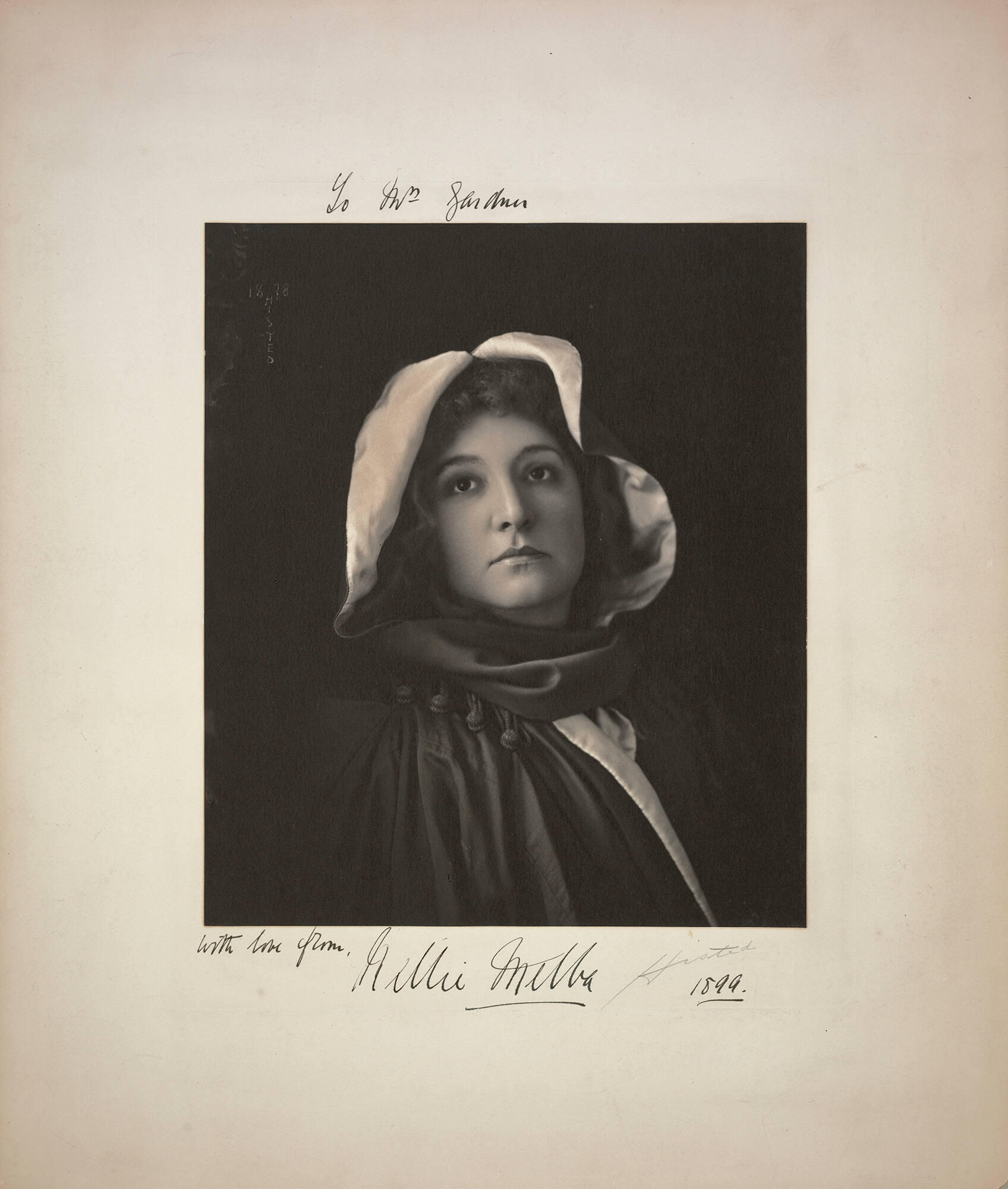
Isabella Stewart Gardner Museum, Boston (ARC.100006)
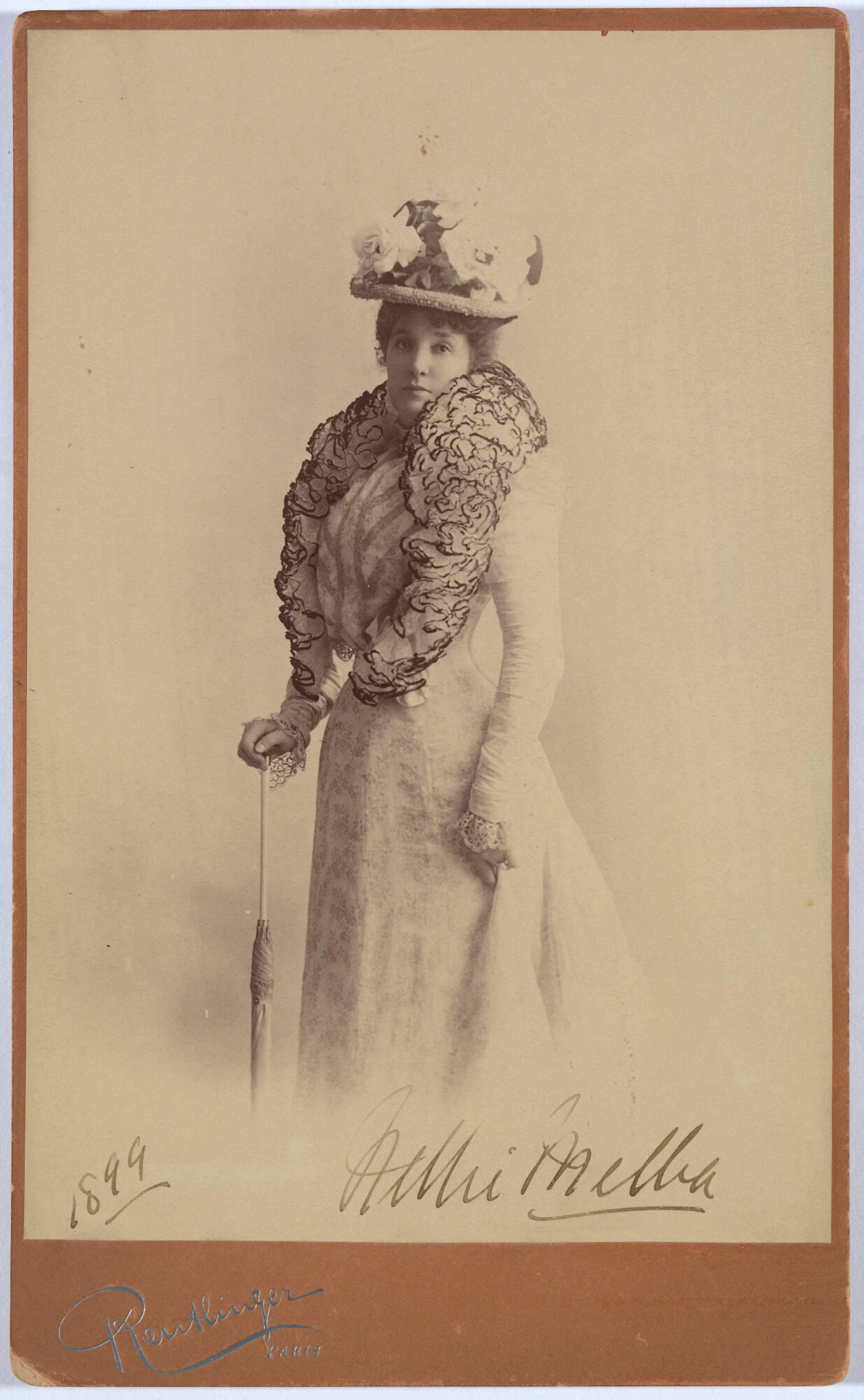
Ernest Walter Histed (American, 1860–1947), Nellie Melba, 1899. Platinum print, 55.9 x 48.3 cm (22 x 19 in.) Inscribed “To Mrs. Gardner/with love from/Nellie Melba, 1899”
It was Isabella’s habit to send out invitations to her concerts with the single word “Music,” not revealing who or what would be performed. One can only imagine the surprise of those wise souls who accepted the invitation when, seated in Mrs. Gardner’s gorgeous Music Room, they were confronted with the world’s most famous singer.
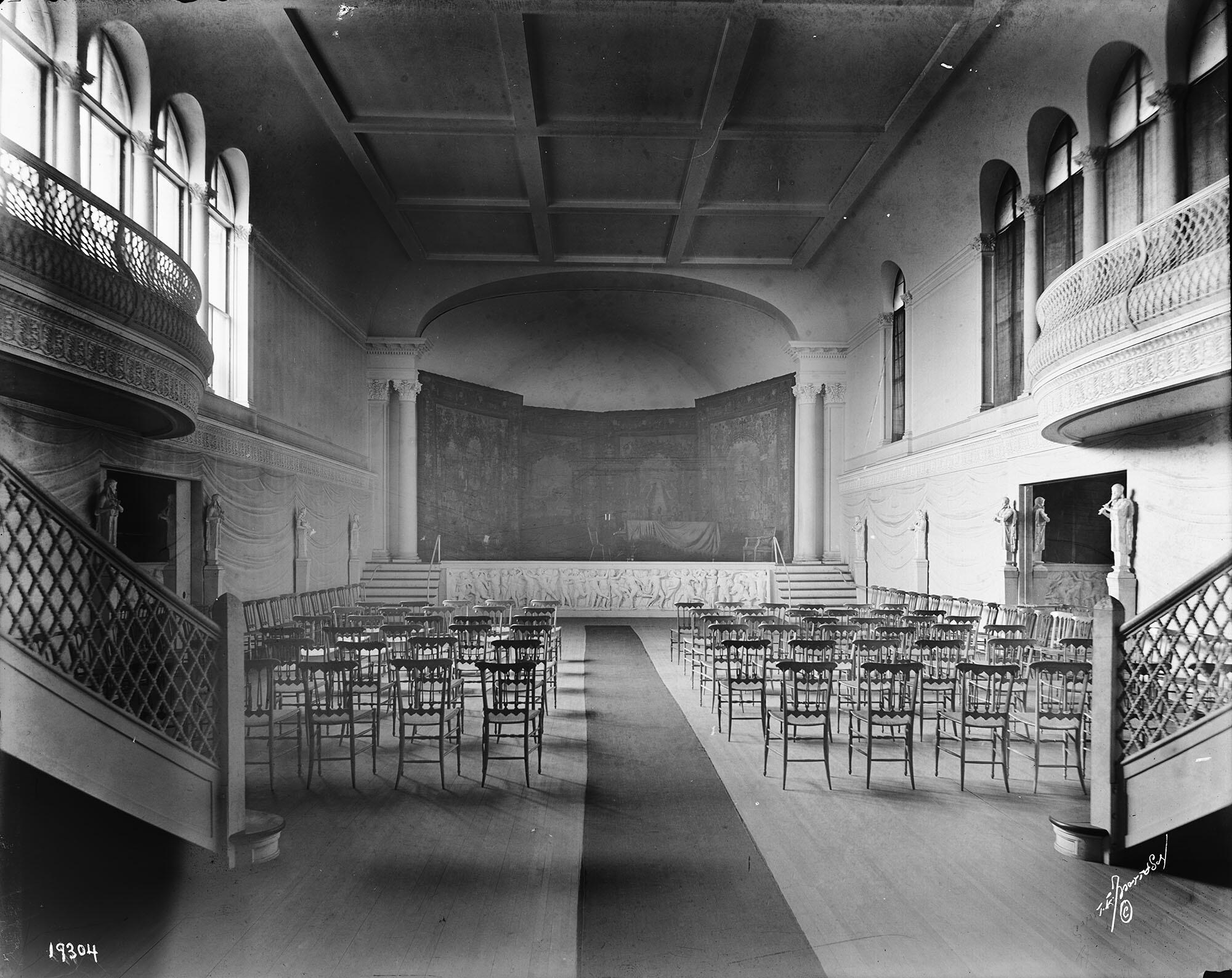
Isabella Stewart Gardner Museum, Boston (Marr19304)
Thomas E. Marr and Son (active Boston, 1910-1942), Music Room, Isabella Stewart Gardner Museum, Boston, 1914
From Melbourne to International Stardom
Nellie Melba was born in 1861 in Melbourne, Australia. Her birth name was Helen Mitchell. From an early age, she was called Nellie (a nickname for Helen), and she fashioned her stage surname to honor her hometown.
She made her operatic debut at the age of 26 and quickly rocketed to international stardom as both an opera and concert singer. Melba became famous enough to join that niche pantheon of operatic artists for whom chefs named dishes. You can still enjoy Peach Melba and Melba Toast with your Tournedos Rossini, Turkey Tetrazzini, and Oeufs Moulés Bizet—and wash it all down with a delicious Bellini.
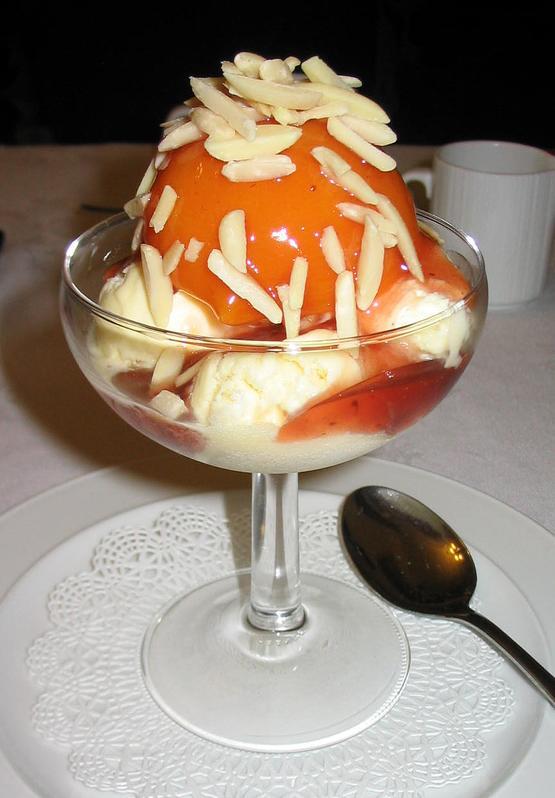
Robbie Sproule, CC BY 2.0 <https://creativecommons.org/licenses/by/2.0>, via Wikimedia Commons
Peach Melba
The Friendship of Isabella and Nellie
Nellie and Isabella met in 1896. Their correspondence reveals a warm and abiding friendship. Melba was among the close friends who helped comfort Isabella when her husband Jack Gardner died in 1898. Isabella displayed many of Nellie’s letters and photographs in the Musicians Case in the Museum’s Yellow Room.
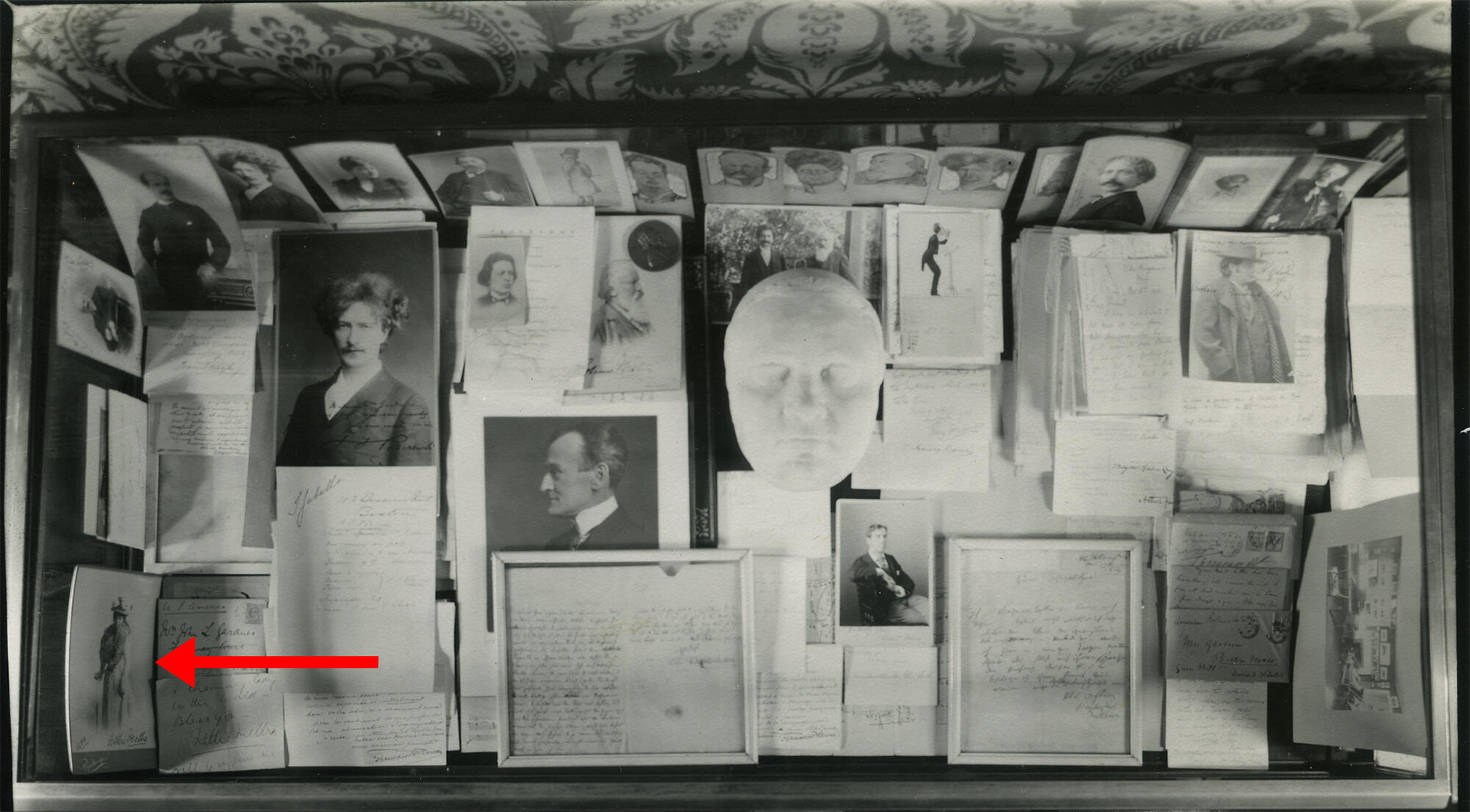
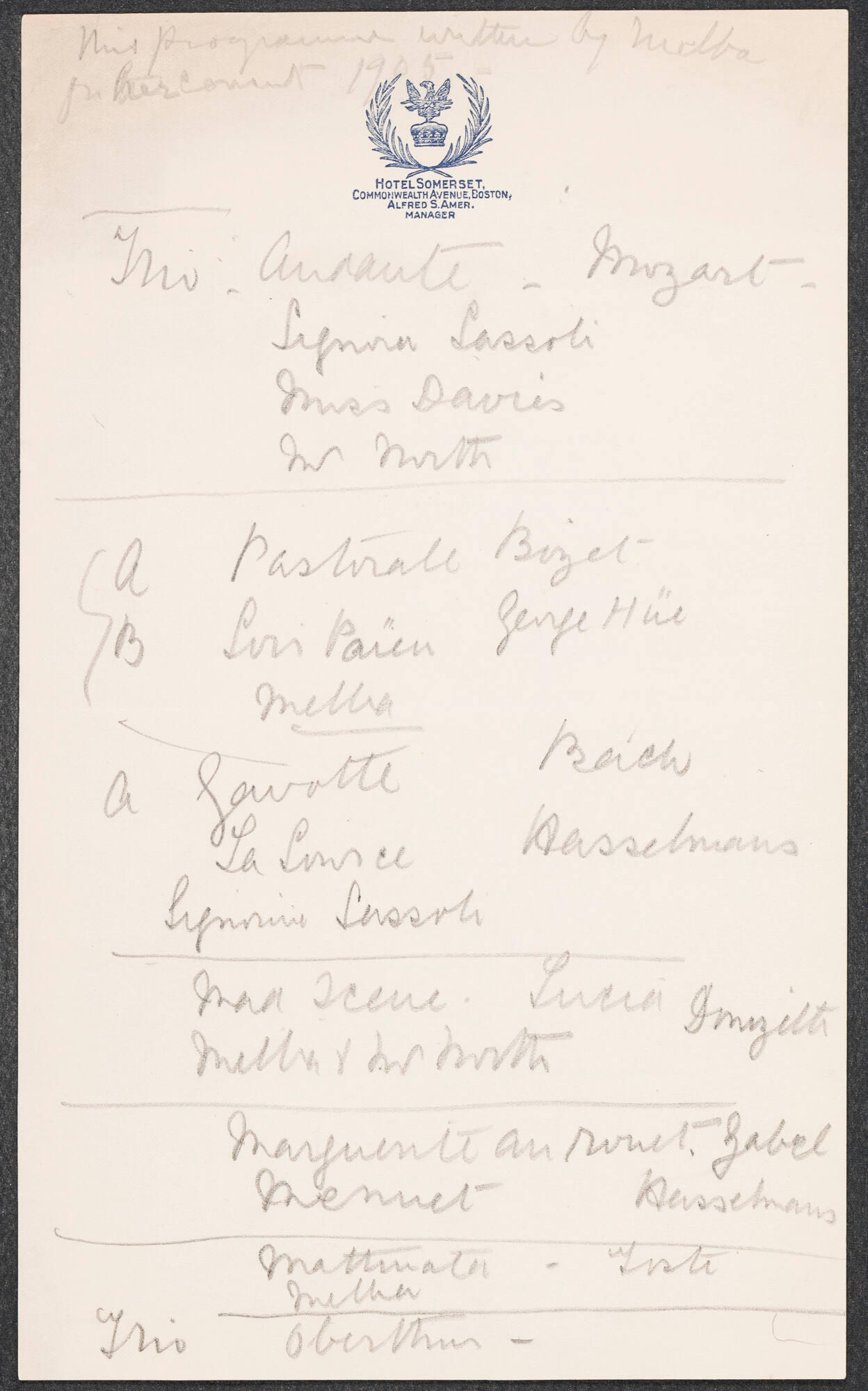
Among the Nellie Melba materials that Isabella added to her collection is a hand written program for the concert she gave at the Museum in 1905.
Isabella Stewart Gardner Museum, Boston (ARC.002320)
Nellie Melba (Australian, 1861–1931), Program for Isabella Stewart Gardner Museum Concert, 1905. Graphite on paper
Reconstructing Nellie’s Performance at the Gardner Museum
I have re-created the “set list” for that concert to allow modern listeners a glimpse of a performance given over 120 years ago. I set out to transcribe this precious document to discover the works Melba performed for what must have been a gob-smacked audience.
But even after deciphering Melba’s penmanship, I had many questions: who are the artists named in the program? What “Trio” of Mozart did they play? What exactly are some of these unfamiliar works?
After some laborious sleuthing, I have uncovered all the works, and been able to find recordings (by modern artists or by Melba and her collaborators themselves) of most of the music.
Listen to the works Nellie Melba performed at the Gardner Museum in 1905 on Spotify.
Opening Numbers
Nellie Melba opened her concert with an instrumental work—the Andantino from Mozart’s Concerto for Flute and Harp, K299—featuring her three collaborators. Italian harpist Ada Sassoli, Boston-based flutist Charles K. North, and Welsh pianist Llewela Davies, were all regular members of Melba’s company.1
The Spotify playlist opens with a modern performance of this slow movement with orchestra. But as a bonus—and to give a better idea of the sound of the performance Isabella heard—this track is followed by a historic recording of the first movement of the concerto (Allegro), performed by Ada Sassoli herself, with John Lemmoné, flute, and Maurice Lafarge, piano.
After the Mozart concerto excerpt, Dame Nellie performed a pair of atmospheric songs. Bizet’s Pastorale depicts an Arcadian idyll; Hüe’s song paints an Orientalist fantasy of ancient days. Both songs would have had particular resonance so near the ancient statues and opulent plantings of the adjacent Courtyard.2
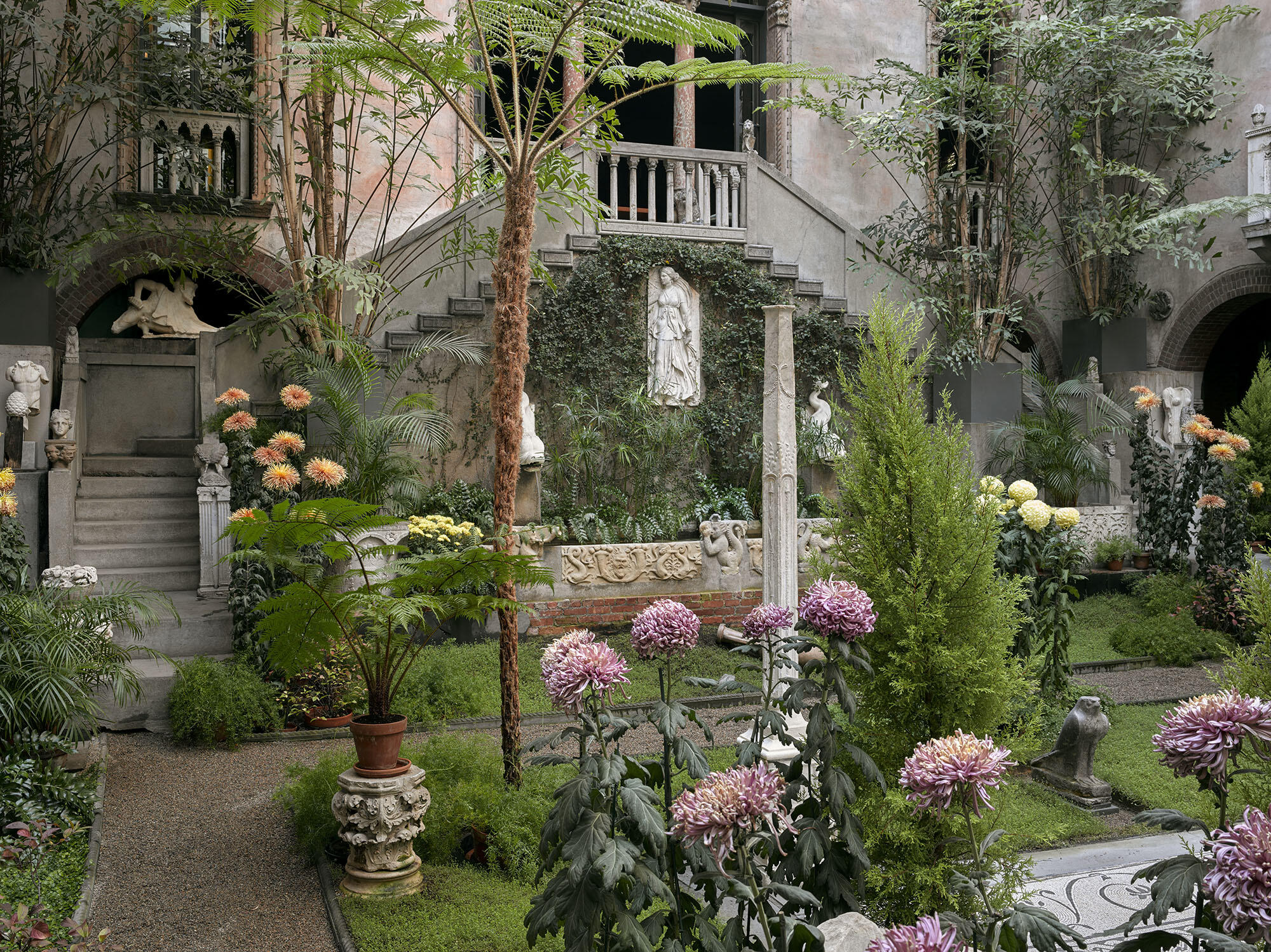
Photo: Sean Dungan
Courtyard, Isabella Stewart Gardner Museum, Boston, 2016
These two songs were followed in Melba’s recital by a pair of works for solo harp.
A Harp Mystery
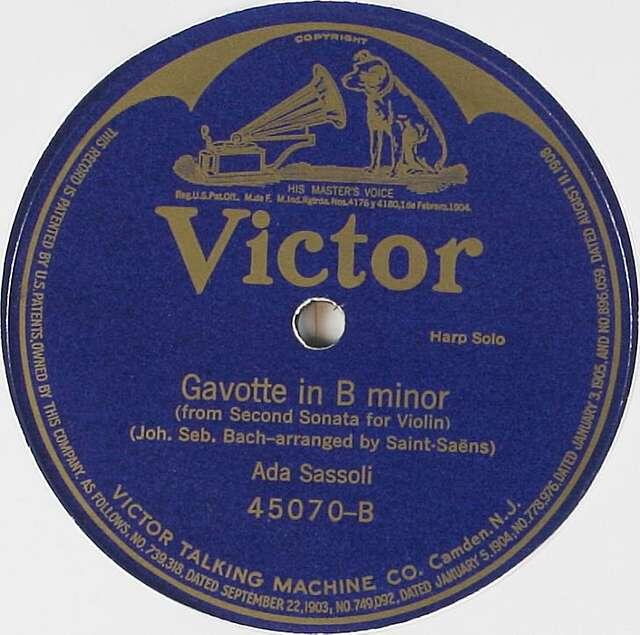
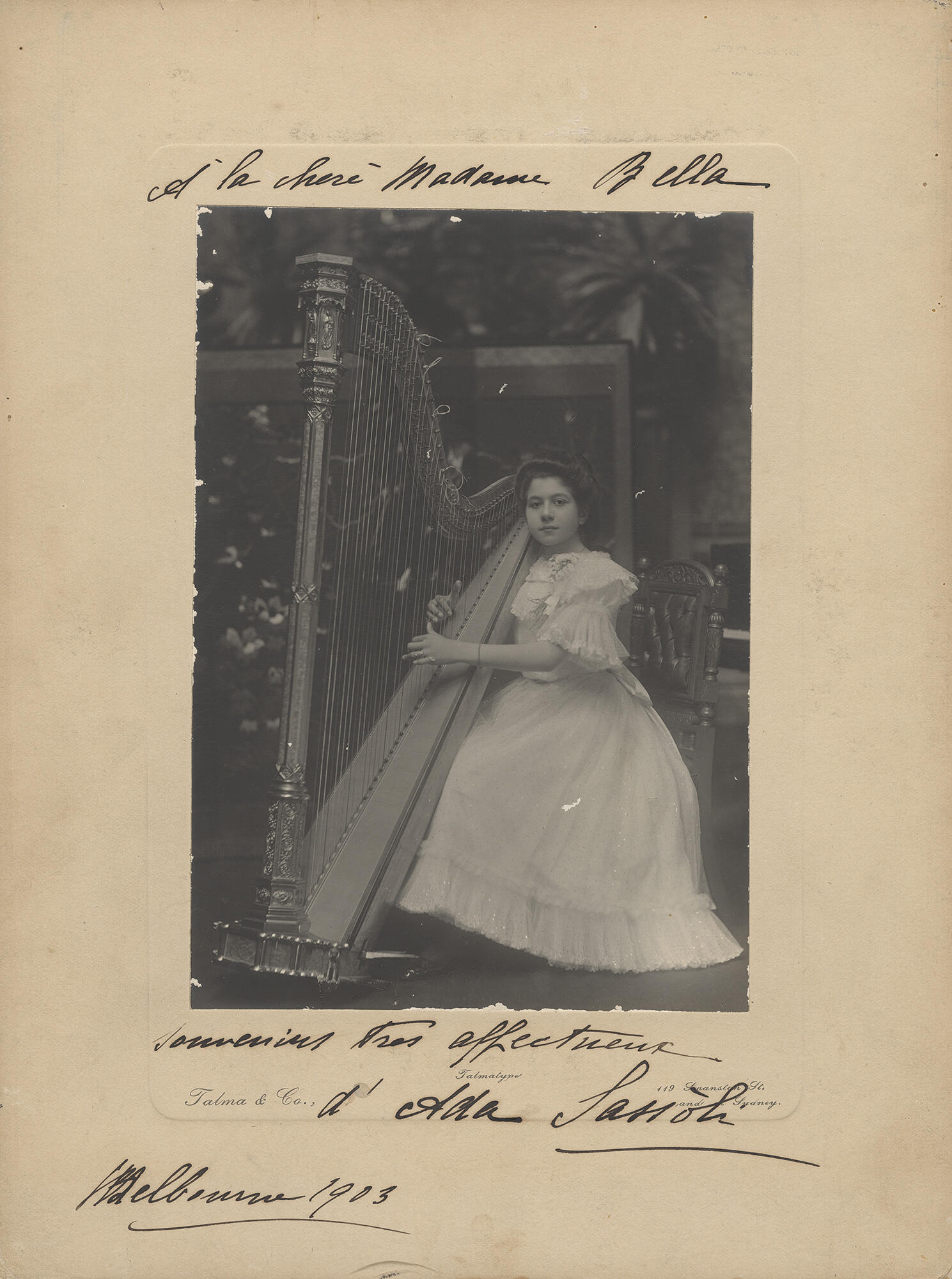
It was a puzzle to figure out what the first harp solo actually was. Melba’s hand-written program lists simply “Gavotte Bach.” An online search turned up a clue in the form of an image of an LP by Sassoli herself.
Retrieved from the Library of Congress, https://www.loc.gov/item/jukebox-131742/
Victor Talking Machine Company (active Camden, New Jersey, 1901–1929), Gramophone disc label for a harp solo, Gavotte in B Minor (from Second Sonata for Violin) by Joh. Seb. Bach—Camille Saint Saëns, Ada Sassoli, 1903–1908
However, this exciting lead proved to add only more mystery: there is no such work by Bach. Happily, Ada Sassoli’s recording turns up on YouTube, making identification easy: the recording reveals the work she played to be the Bourée from Partita No. 1 for unaccompanied violin!
State Library Victoria (Australia)
Talma & Co. (active Sydney, 1899–1922), Ada Sassoli, about 1903. Photograph
The error was not Sassoli’s. She was indeed playing Saint-Saëns’s transcription for piano of Bach’s original (adapted by Sassoli for the harp). In the first edition of Saint-Saëns music, the Bach source is given incorrectly as “Gavotte from the 2nd Violin Sonata,” just as it appears on Sassoli’s recording.
Finally, around 1940, the French publisher Durand issued a new edition of the Saint-Saëns transcriptions. The Bourrée is at last correctly named with a footnote acknowledging the earlier error.
At last, we can name the work performed at the Gardner Museum in 1905.
Tempo di Borea [Bourrée], 7th mvt, from the Partita No. 1 for Unaccompanied Violin, BWV 1002 after the arrangement for piano by Camille Saint-Saëns, in Bach Fragmente, No. 4 “Gavotte aus der 2en Violin-Sonate” [recte: Bourrée from Bach’s First Partita for solo violin]
We can hear Sassoli herself play it on YouTube, but alas, this track is not available on Spotify; on our playlist, I have included a performance by harpist Lily Laskine (1893–1988).
After this Bourreé, Signora Sassoli offered a second harp solo, “La Source” (The Stream) Op. 44 (1898). The music was written by Belgian harpist and composer Alphonse Hasselmans (1845–1912), Sassoli’s teacher in Paris. The coruscating arpeggios of the harp echo depict the trickle of water in a brook; and would have echoed the fountain in the nearby Courtyard of the Museum.
Nellie's Gothic Chiller, Lucia di Lammermoor
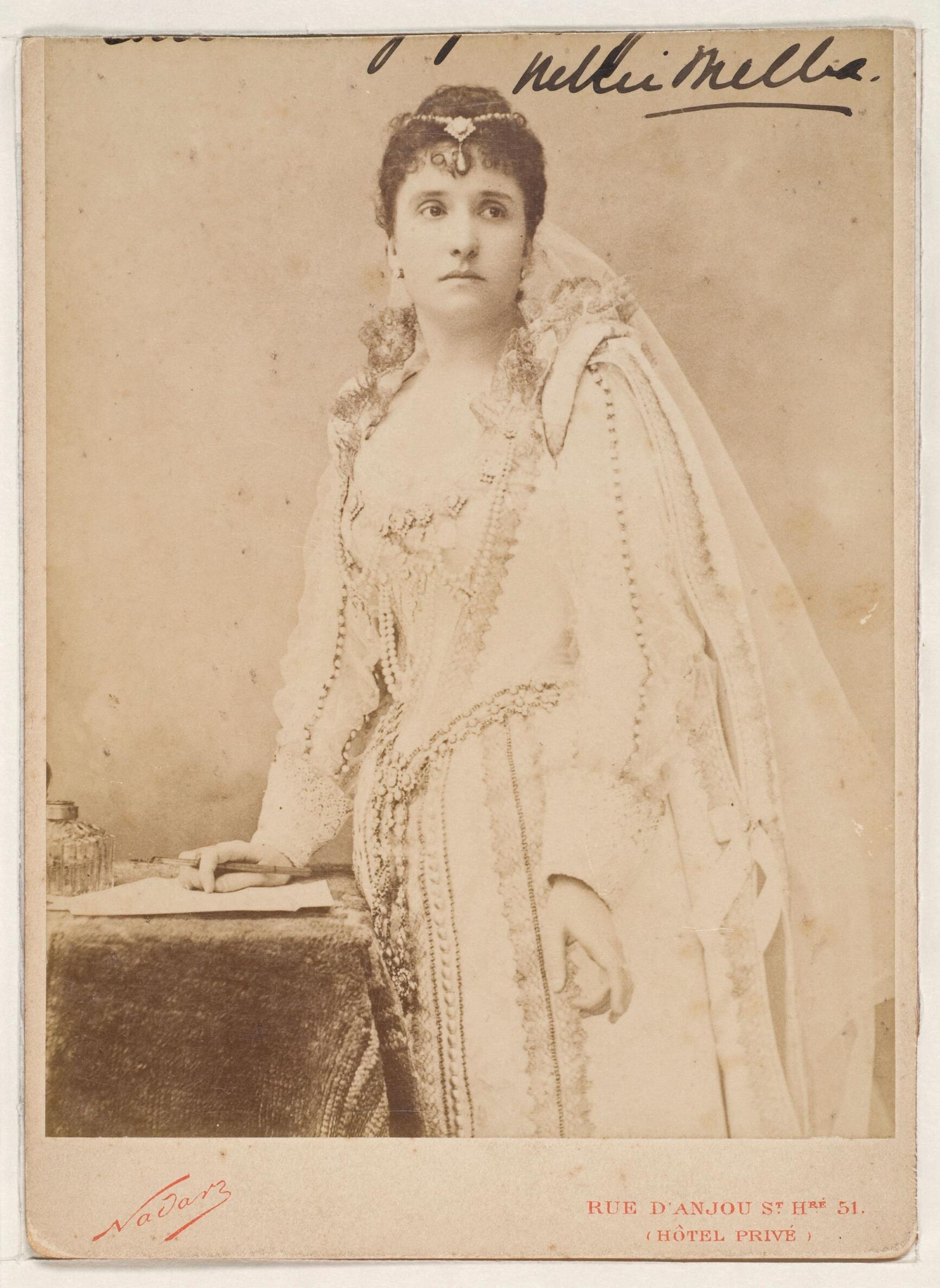
After Signora Sassoli’s two solos, Dame Nellie offered a classic of the bel canto opera repertoire, the mad scene from Donizetti’s gothic chiller Lucia di Lammermoor, based on Walter Scott’s novel The Bride of Lammermoor.
State Library of New South Wales (YzOg7pX9)
Nadar (French, 1820–1910), Nellie Melba, in costume for "Lucia di Lammermoor," about 1888
The opera tells the story of Lucia, who is burning to marry her true love Edgardo. But her brother, out of expediency, forces her to marry Arturo, whom she does not love. In agony, she goes mad and eventually murders Arturo.
Donizetti’s mad scene takes place just after the murder, with Lucia in her nightdress covered in blood. (Carrie has nothing on Lucia!) This is the paradigmatic operatic mad scene, made up of many parts and changing tempo and style on a dime.
This is a perfect fit in Melba’s recital. It is a thrilling showpiece for a soprano; and it is a work in which she had triumphed in her Metropolitan Opera début.
Fortunately for us, Melba recorded the scene at least twice. Our playlist has Melba’s own recording of a portion of the aria with her colleague and flutist, Charles K. North.
More Harp
After this vocal tour-de-force, the concert at the Gardner continued with two more harp solos: Albert Zabel’s “Marguérite Douleureuse au Rouet” for harp, Op. 26 and Alphonse Hasselmans’s Menuett.
Albert Zabel (1834–1910) was a Russian harpist. His tone-poem for harp wordlessly depicts a celebrated scene from Goethe’s Faust: young Gretchen sits at her spinning wheel, yearning for Faust—singing her haunted yearning over the relentless spinning of the wheel.
Our Spotify playlist has a performance by Floraleda Sacchi. We can hear Signora Sassoli’s performance of the Menuett on YouTube.
Paolo Tosti’s Mattinata
Next, Dame Nellie sang the torch song “Mattinata” by Paolo Tosti (1846–1916), whose music she often included on her recitals and Isabella also admired. Luckily, Melba recorded “Mattinata” in 1904, giving us a contemporary idea of how she might have sung this at the Gardner.
A Final Trio
The program came to its end with another instrumental work. While Melba writes only “Trio” on the program, looking at other performances on Melba’s tour reveals what they played—Sassoli, North, and Davies played it on several other Melba concerts: Charles Oberthür’s Romance and Finale for Harp, Flute, and Piano.
Alas, I could not turn up any recordings of this work, nor uncover the score, so they are absent from our playlist.
The Encore from the Dutch Room Balcony
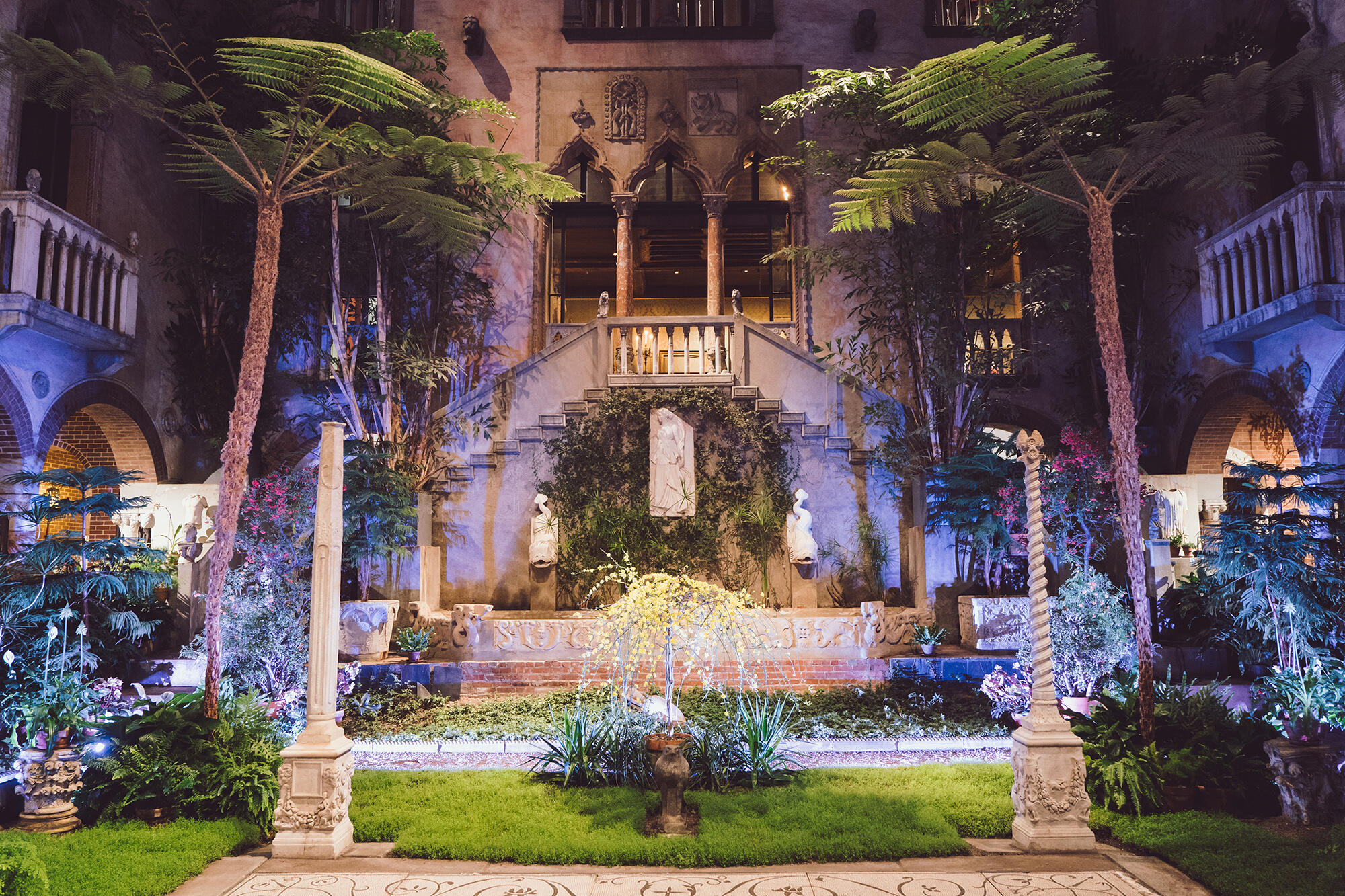
It was surely a dazzling concert, and a coup for Isabella. But she had one more bit of drama up her sleeve. Later in the evening, as the guests were enjoying the splendors of the Courtyard lit by torchlight at night, Nellie Melba appeared again, at the top of the Dutch Room stairs. There she offered an encore to the guests, singing out into the expansive acoustic of the four-story atrium.
Isabella Stewart Gardner Museum, Boston. Photography by David Pérez Pictures
The Dutch Room Balcony in the Courtyard, 2024
There is no known record of what Mebla’s encore was at her Gardner Museum concert. No doubt she would have wanted to sing something for Isabella’s evening that would, as one reviewer wrote of Melba’s encores, “send her hearers into spasms.”
My own suspicion is that Nellie would have sung one of Isabella’s favorite songs, Jean-Paul-Égide Martini’s “Plasir d’amour.” Melba is documented to have performed “Plasir d’amour” as one of her encores on other concerts. Sadly, she does not seem to have recorded it, so to close our Spotify playlist, I have included a performance for voice and guitar by a latter-day superstar of a different type: Joan Baez. You can also listen to Elvis Presley’s version, “Can’t Help Falling in Love with You.”
1 I was able to give “Mr. North” his full name thanks to a pandemic-era online project called “The Soprano-Flute Collaborations of Nellie Melba” by Jessica Raposo. Paula Robison and Nancy Toff kindly led me to additional biographical detail.
2The curious can read the original texts and translations for these two songs here:
Pastorale. Soir Païen.
You May Also Like

Read More on the Blog
Ethel Smyth: Composer and Activist

Learn More
Music at the Gardner

Read More on the Blog