
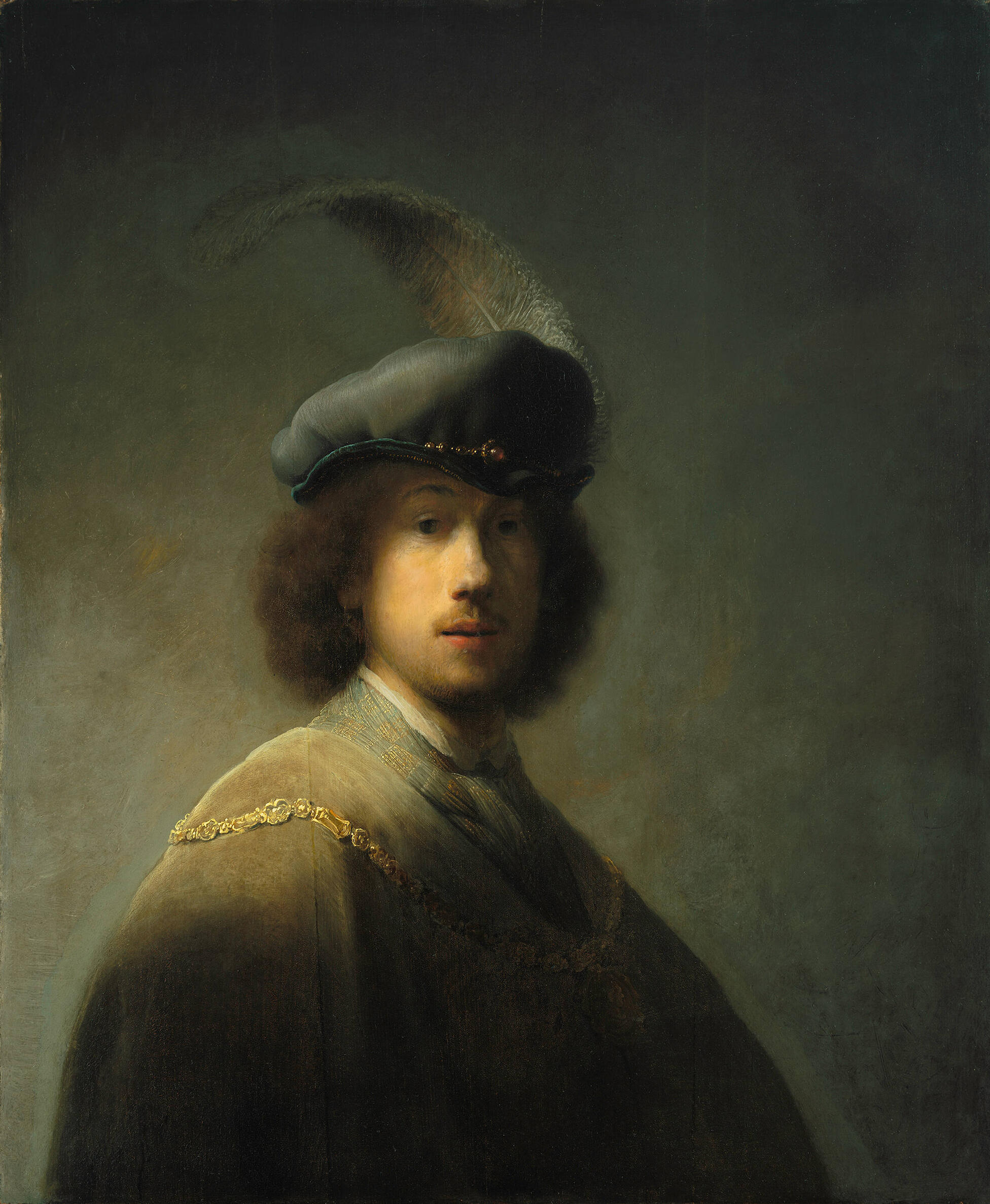
A detail that stands out in Rembrandt’s Self-Portrait, Age 23—normally on view in the Dutch Room and one of the focal points of the exhibition The Book of Esther in the Age of Rembrandt—is the artist’s scarf. Upon close inspection, we see that it is striped with what appears to be strips of metal foil, or metal-wrapped threads. This one accessory speaks volumes about the painter and his ambition, foreshadowing the future of his long career.
Isabella Stewart Gardner Museum, Boston (P21n6)
Rembrandt van Rijn (Dutch, 1606–1669), Self-Portrait, Age 23, 1629. Oil on oak panel, 89.7 x 73.5 cm (35 5/16 x 28 15/16 in.)
Rembrandt Setting the Scene
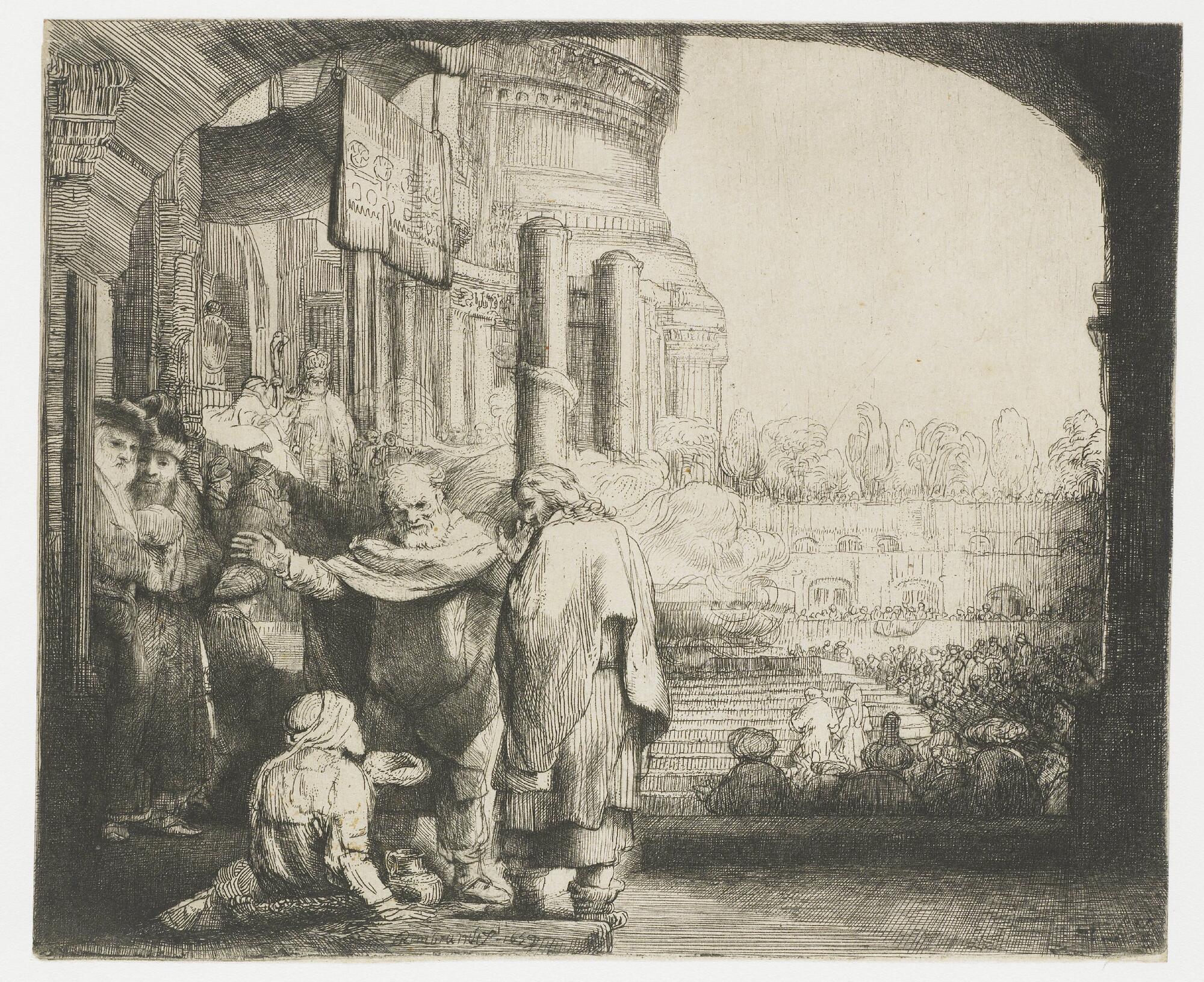
Rembrandt was a young man, still living and working in his hometown of Leiden, when he dressed for his self-portrait in 1629. A few years later, he relocated to cosmopolitan Amsterdam, where he became famous for contemporary portraiture and figural scenes depicting Biblical narratives. The painter lived and worked in a bustling immigrant Jewish community, where he created etchings, drawings, and painted studies based on his neighbors.
Rijksmuseum, Amsterdam (RP-RP-P-1961-1040)
Rembrandt van Rijn (Dutch, 1606–1669), Peter and John Healing a Paralyzed Man at the Temple Gate, 1659 Etching and drypoint, 17.9 × 21.8 cm (7 x 8 9/16 in.). The figures on the left are believed to be modeled by Rembrandt’s Jewish neighbors.
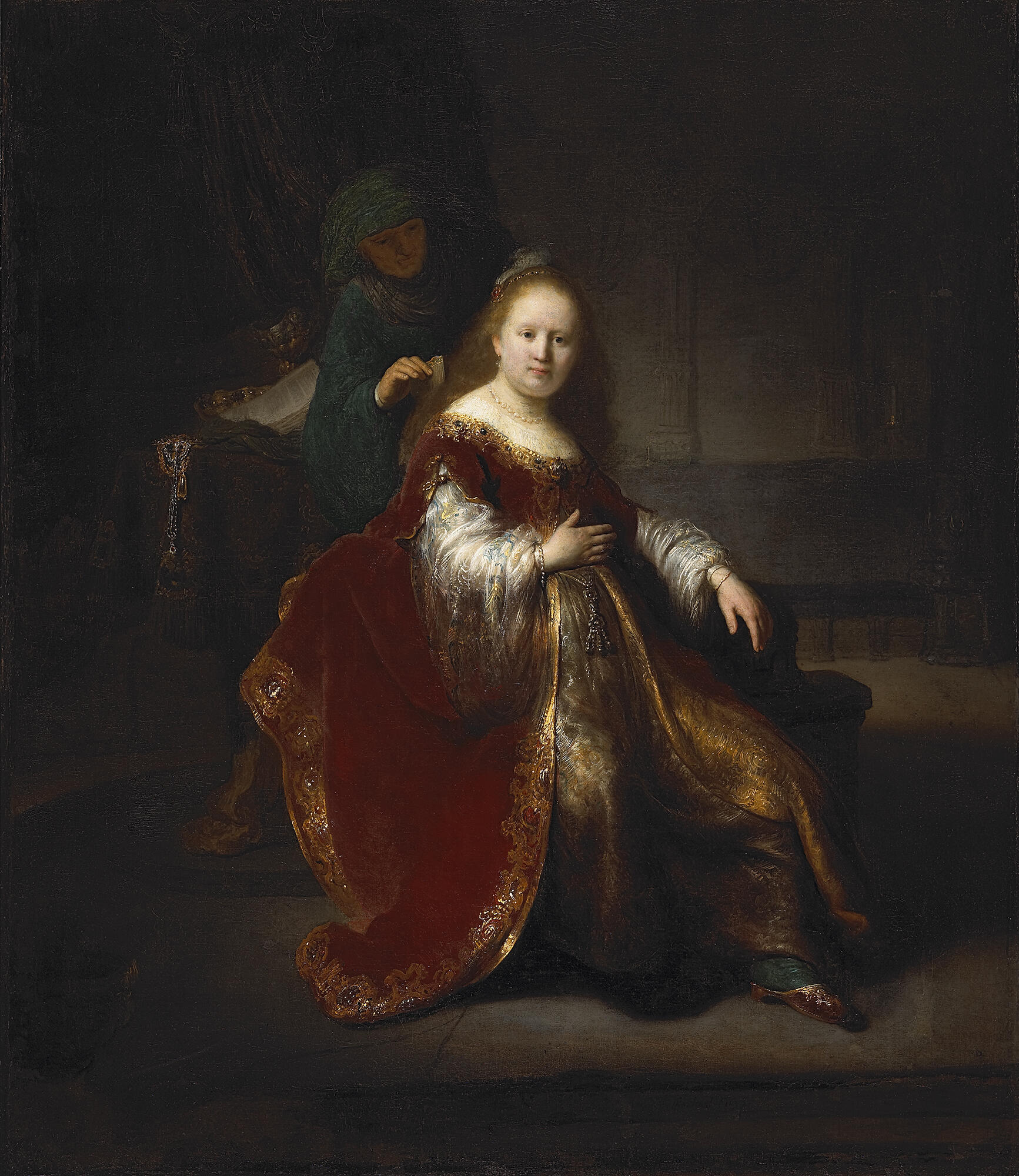
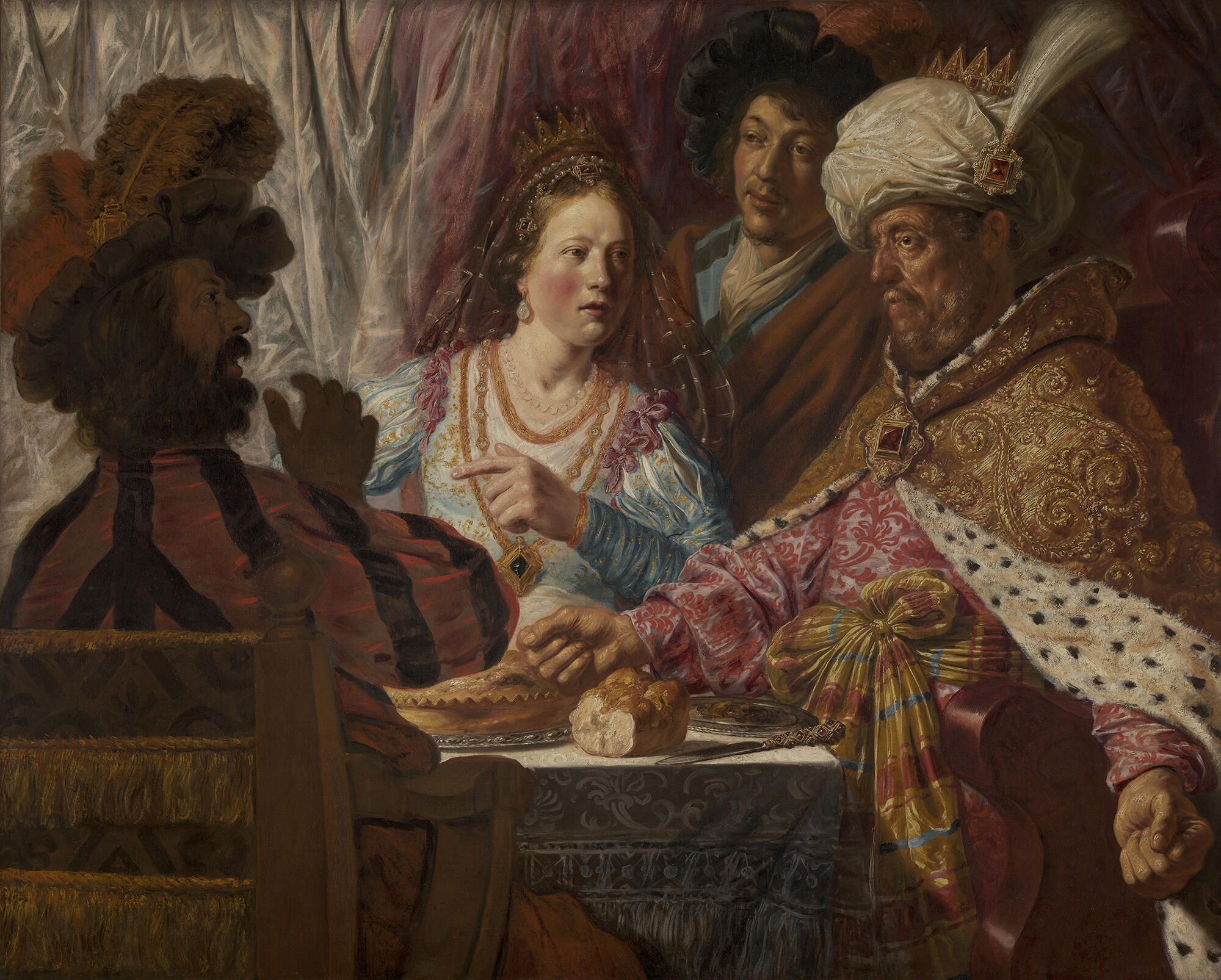
These studies would inform his historic paintings depicting stories found in the Jewish Bible, such as the Book of Esther, which takes place in ancient Persia. Rembrandt’s painting of Esther (about 1632–1633, National Gallery of Canada) shows a lavishly dressed queen, while The Feast of Esther (about 1625, North Carolina Museum of Art) painted by Rembrandt’s peer and rival, Jan Lievens, shows a turbaned king with a striped sash and golden cloak. How did Rembrandt and other painters use textiles to set the scene for the far-away long ago “East” that is referenced in these paintings?
Luxurious Safavid and Ottoman Textiles in the Netherlands
Silk textiles with metal-wrapped threads, such as the one that we see in his early self-portrait, were easily obtained through the bustling trade in “exotic” goods brought in from the Islamic world, including Ottoman Turkey and Safavid Iran. Trade was officially established with these eastern markets in 1602 with the founding of the Dutch East India Company, Vereenigde Oostindische Compagnie (VOC). One of the first joint-stock companies in the world, the VOC was granted trading rights in Safavid lands in 1623 and thereafter became the most active trading partner in Iran, supplying shiploads of goods across a vast network spanning the globe.
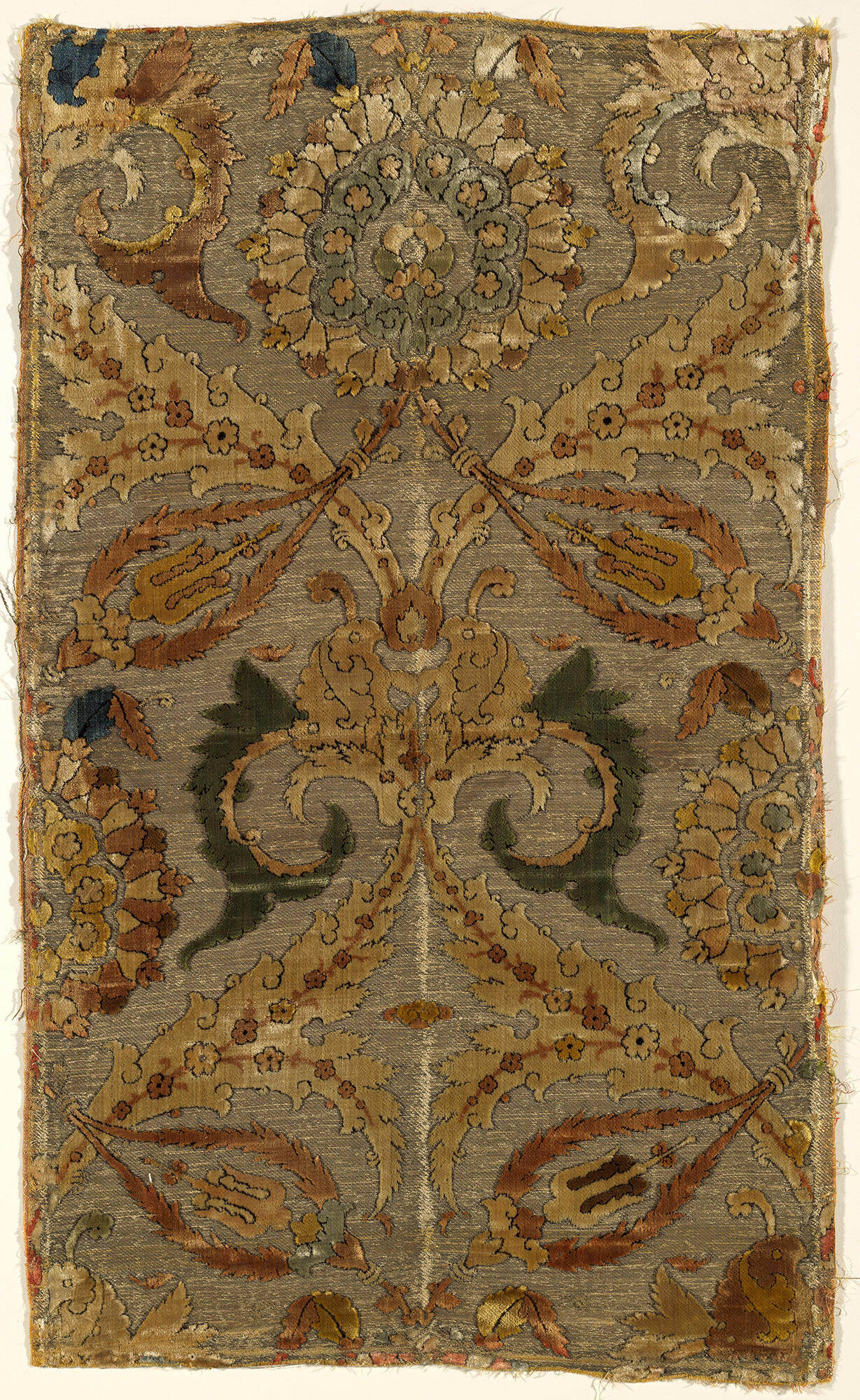
Isabella Stewart Gardner Museum, Boston (T26n2)
Persian, Furnishing or Garment Fabric, 1567–1633. Silk and foil-wrapped silk velvet, 57.2 x 33 cm (22 1/2 x 13 in.). An example of the kind of silk textiles with metal wrapped threads used for garments and furnishings that were traded in the Netherlands during Rembrandt’s time.
Textiles were especially prized goods due to their portability, and the inherent value of a gold-and-silk scarf such as that worn by Rembrandt was a quick way to communicate wealth and worldliness to the viewer. Often referenced in Dutch sources simply as “Turkish”—Istanbul being the nearest Eastern entrepôt from which the silks would reach the Netherlands—these silks could have been produced in either Safavid or Ottoman territories, which ruled much of the Islamic world in the first quarter of the seventeenth century.
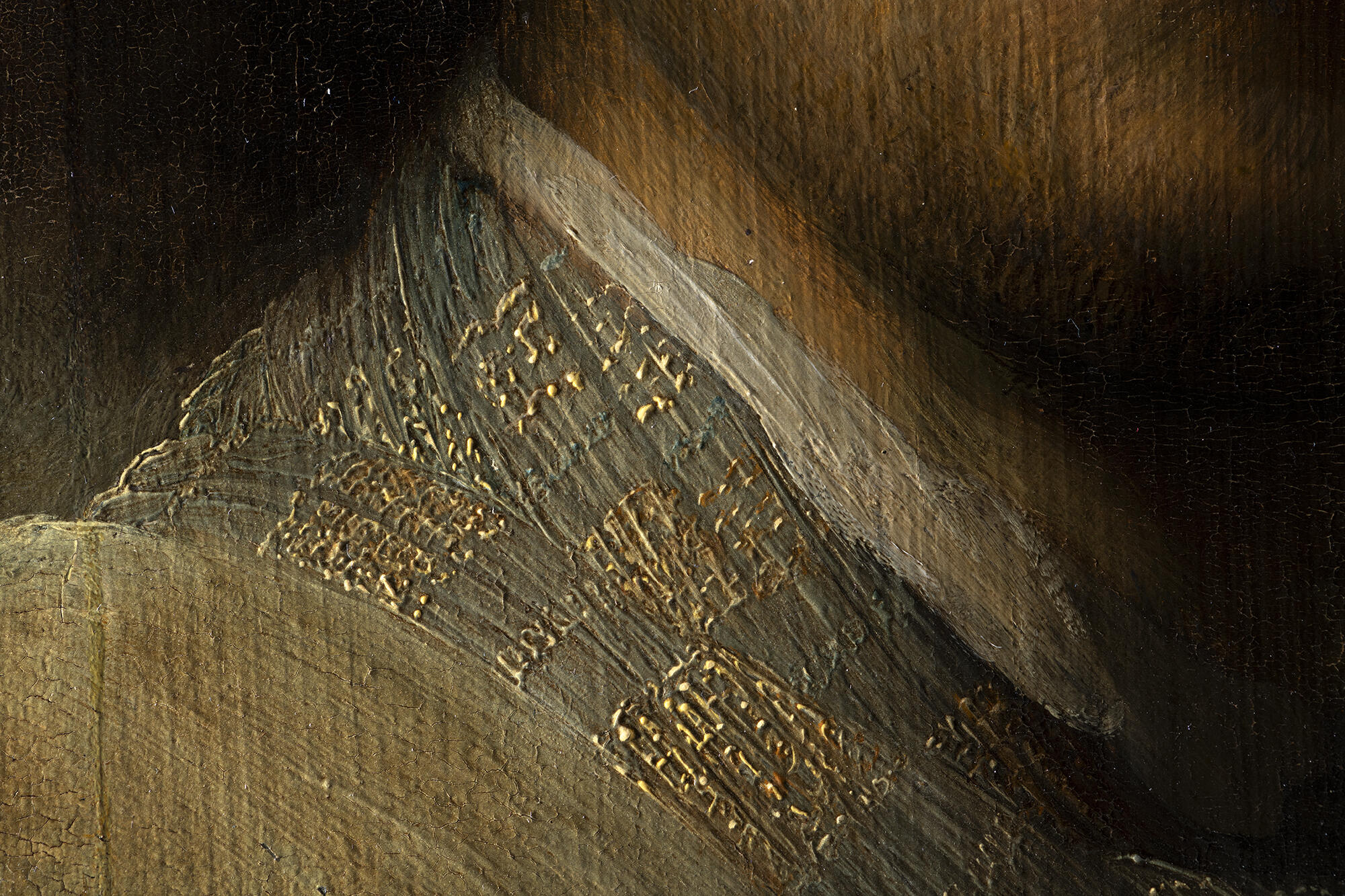
Isabella Stewart Gardner Museum, Boston (P21n6)
Detail of the scarf showing the metallic threads, in Rembrandt’s Self-Portrait, Age 23, 1629
Cummerbunds and Turbans
Striped silks are seen in the Islamic world most often as wide waist sashes (Per. kamarband), as well as headwear (Per. dulband), amalgamated as the “cummerbund” and “turban,” respectively. A typical Safavid sash or turban wrap was 24 to 26 inches wide and up to 120 inches long, requiring an intricate ritual of folding, wrapping, knotting and tucking in the ends or—less typically in this period—letting them hang down.
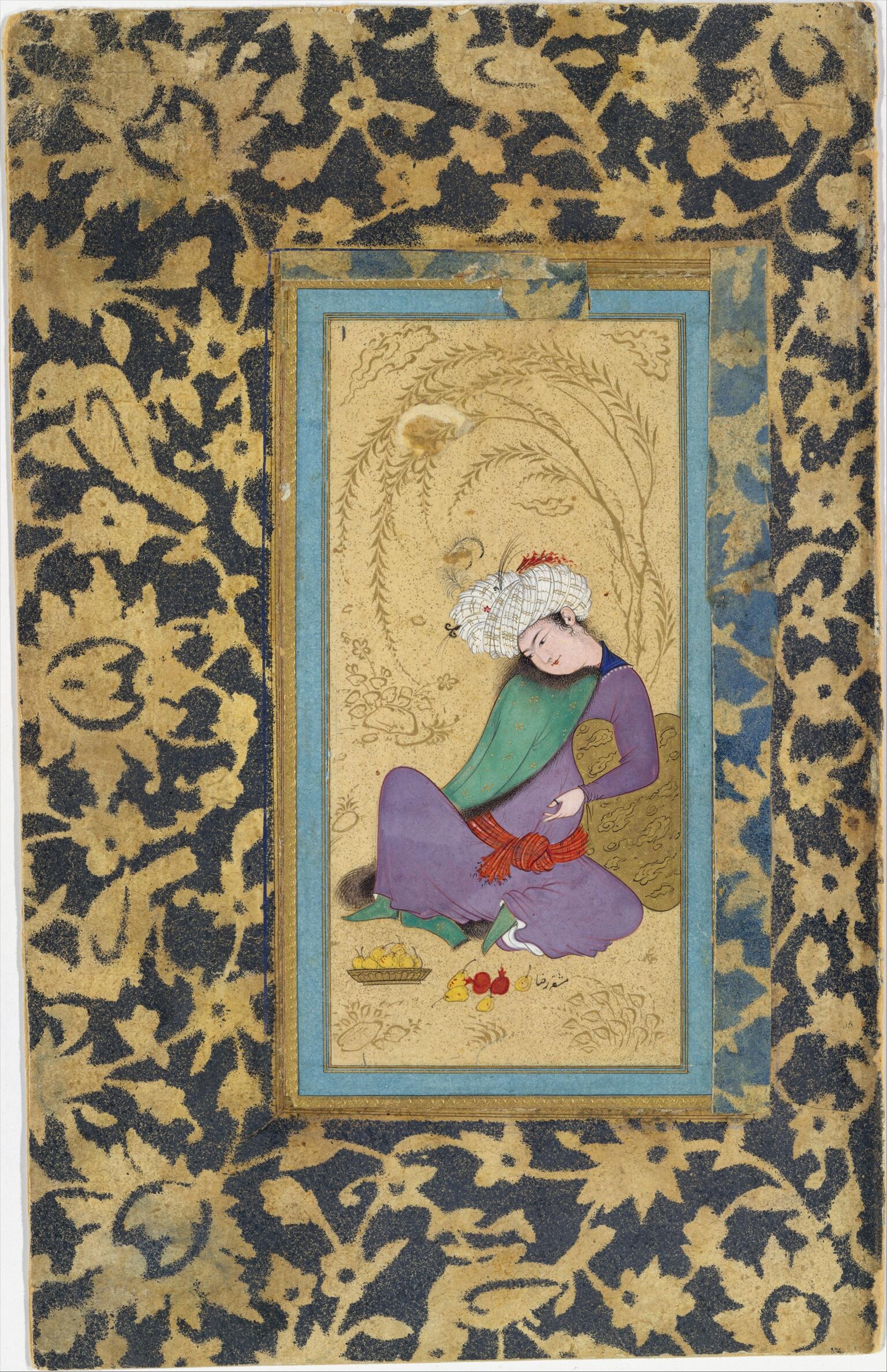
The Metropolitan Museum of Art, New York (55.121.39)
Painting by Riza-yi 'Abbasi (Iranian, about 1565–d. 1635), Man in a Fur-Lined Coat, about 1600. Ink, opaque watercolor, and gold on paper, 13.6 x 6.4 cm (5 3/8 x 2 1/2 in.)
The process was equally complicated for turbans, which appear in several of Rembrandt’s oil paintings including his Self-Portrait in Oriental Attire (1631, Petit Palais, Paris) and Man in Oriental Costume (1635, National Gallery, Washington DC), which were both modelled using Persian or Turkish examples. The message sent by the turban in particular, regardless of its reinterpreted modeling, was that the character was of Eastern or Jewish origin, and—in the case of metal-thread fabrics—that the person depicted was wealthy.
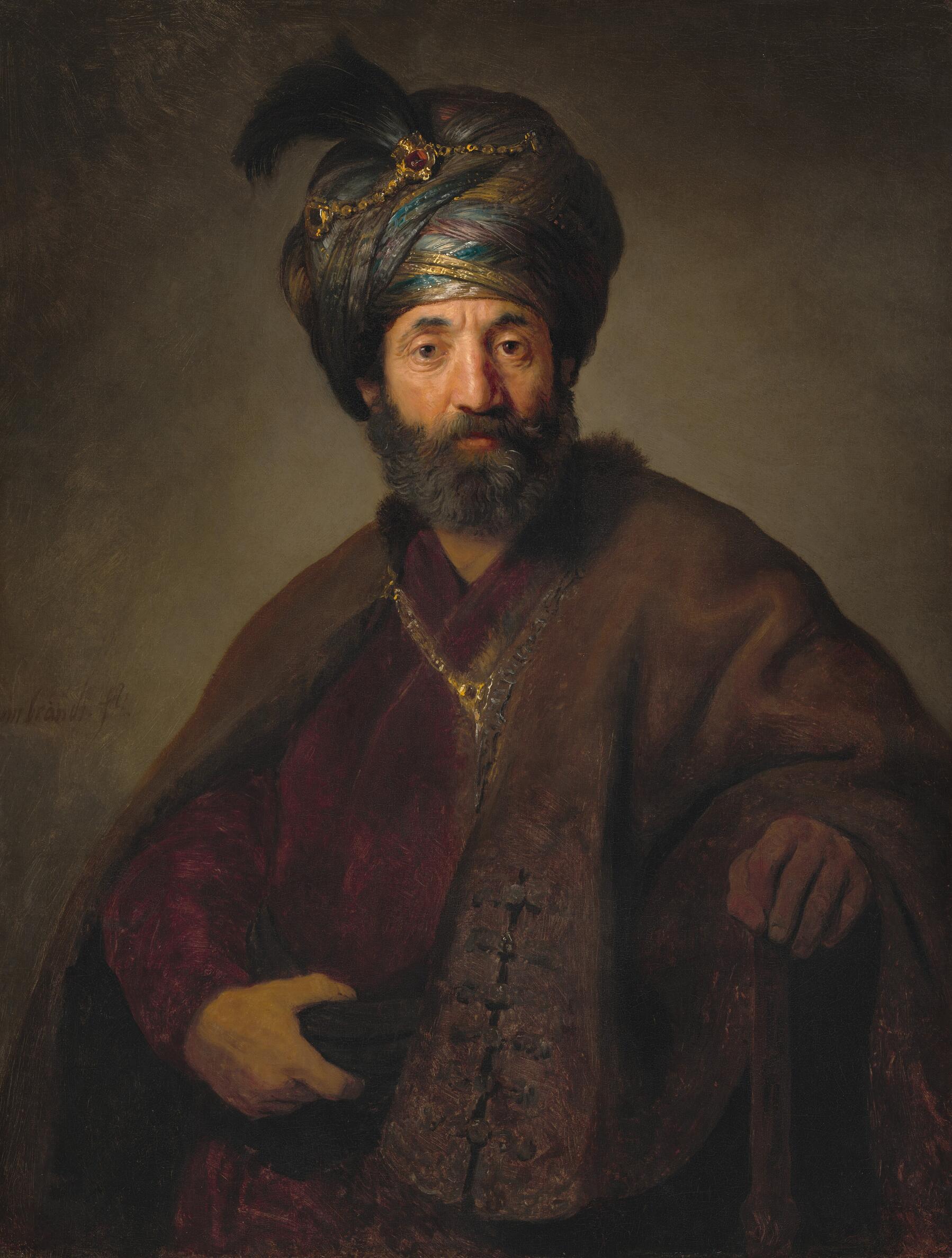
National Gallery of Art, Washington DC (1940.1.13)
Rembrandt van Rijn (Dutch, 1606–1669) and Workshop (Probably Govaert Flinck), Man in Oriental Costume, about 1635. Oil on linen, 98.5 × 74.5 cm (38 3/4 × 29 5/16 in.)
Although portraits of Safavid and Ottoman ambassadors circulated in early modern Europe, in many cases Rembrandt’s use and style of these fabrics do not reflect those in their original locations; in his Self-Portrait, Age 23, Rembrandt wears the fabric as a cravat. Whether Rembrandt was unfamiliar with the Turkish and Persian styles or wanted to create a fictional “other” that was purposefully ambiguous remains open to interpretation. In his etching The Persian (1632), Rembrandt shows what may be a Turkish or Persian silk sash fashioned into a short, belted wrap-around coat (Per. qaba or jama), forming a fringed hem that was atypical in the region.
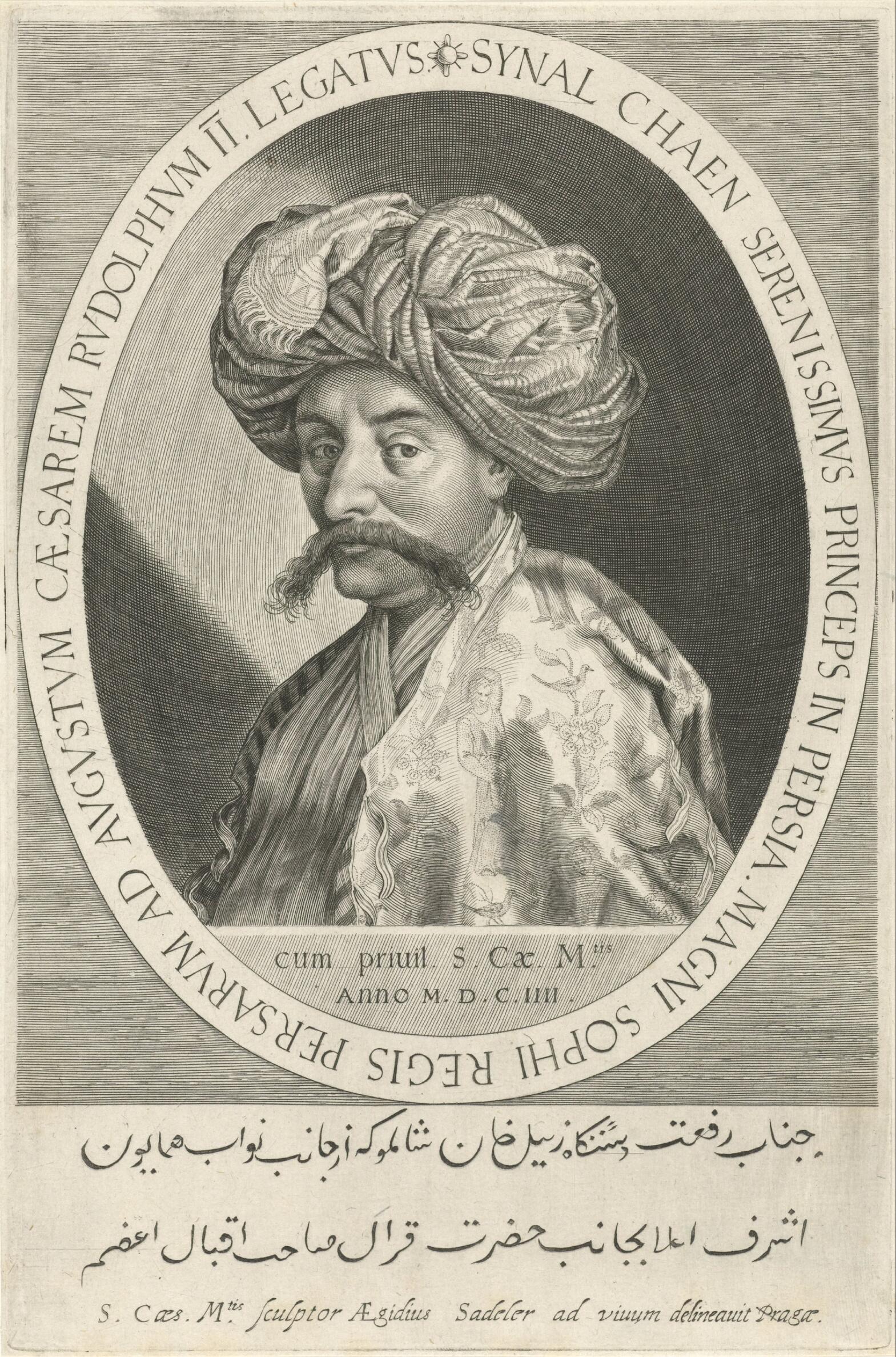
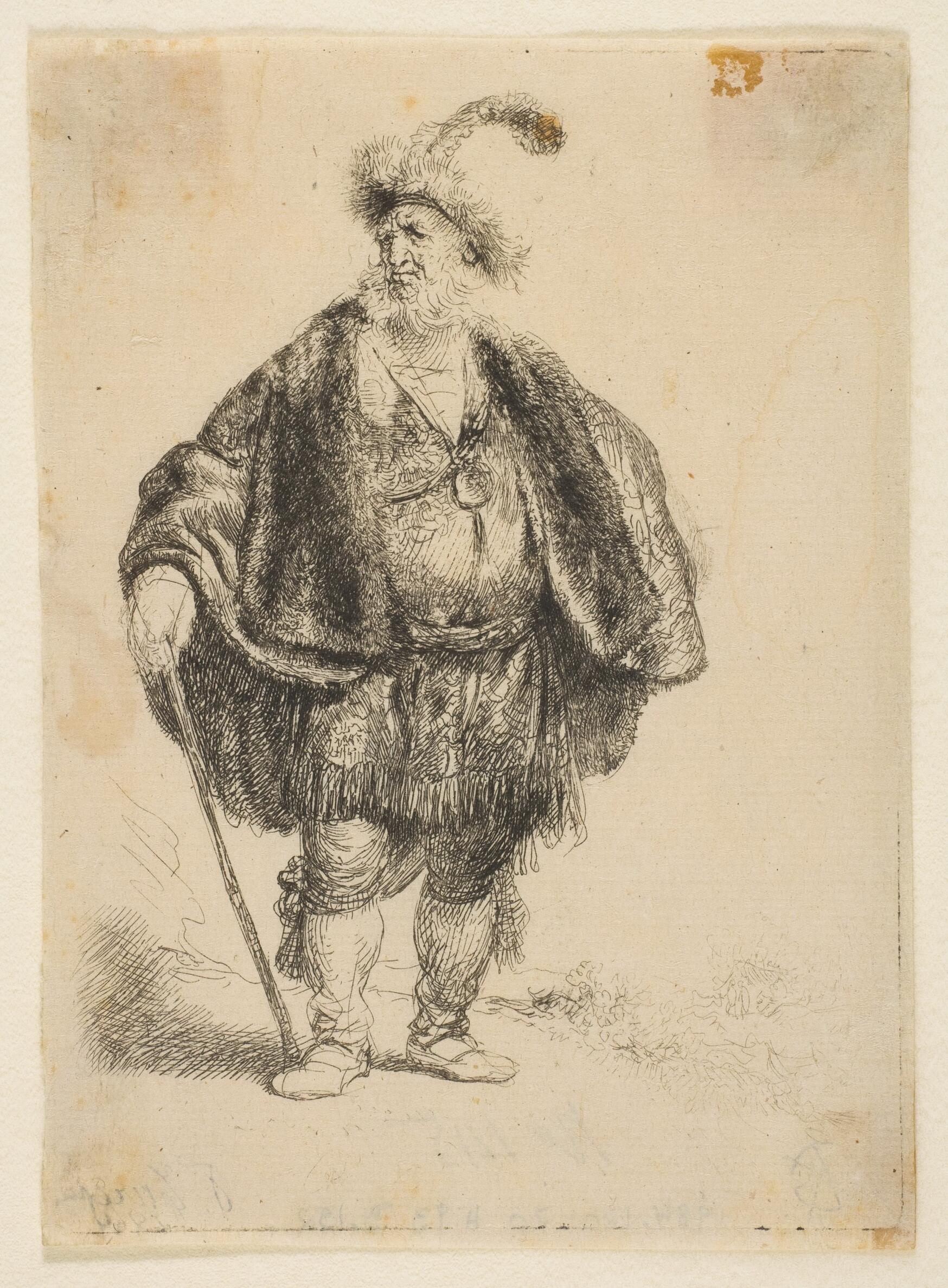
It was not unusual at the time for artists to use what was available to them, often repurposing objects from their kunstkamer or wunderkammer (cabinet of curiosities) to create new narratives. The striped blue scarf that appears in Saul’s turban in David Playing the Harp for Saul (1630-31, Städel Museum, Frankfurt am) may be the same one that’s around the artist’s neck in the Gardner Self-Portrait.
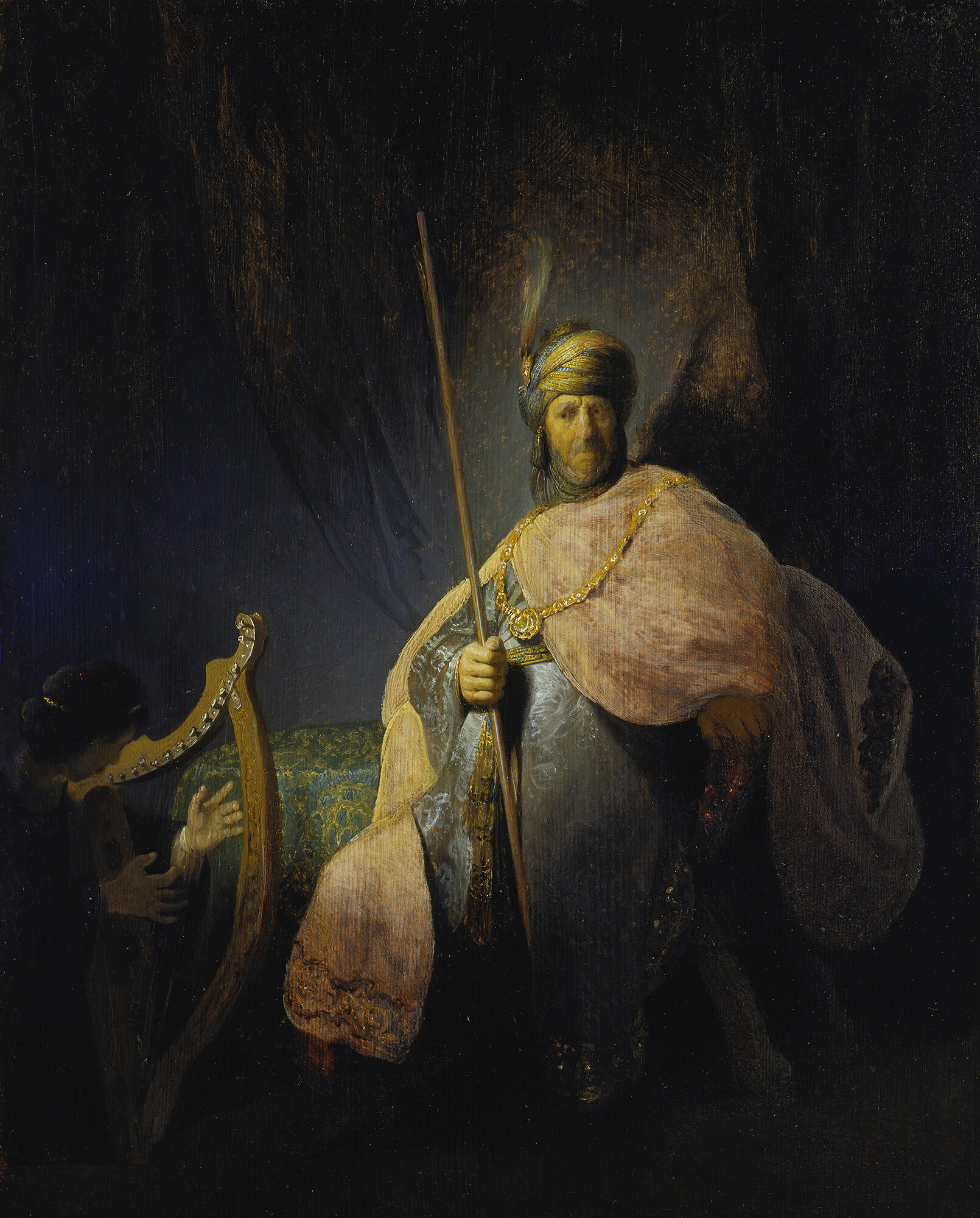
Städel Museum, Frankfurt am Main
Rembrandt van Rijn (Dutch, 1606–1669), David Playing the Harp for Saul, about 1630–31. Oil on panel, 62 × 50.1 cm (24 3/8 x 19 ¾ in.)
Rembrandt would refashion his exotic silks in a later self-portrait (1658, Frick Collection), aggrandizing himself in the pose of an Eastern prince at the height of his career, while also ironically declaring bankruptcy due to financial mismanagement.
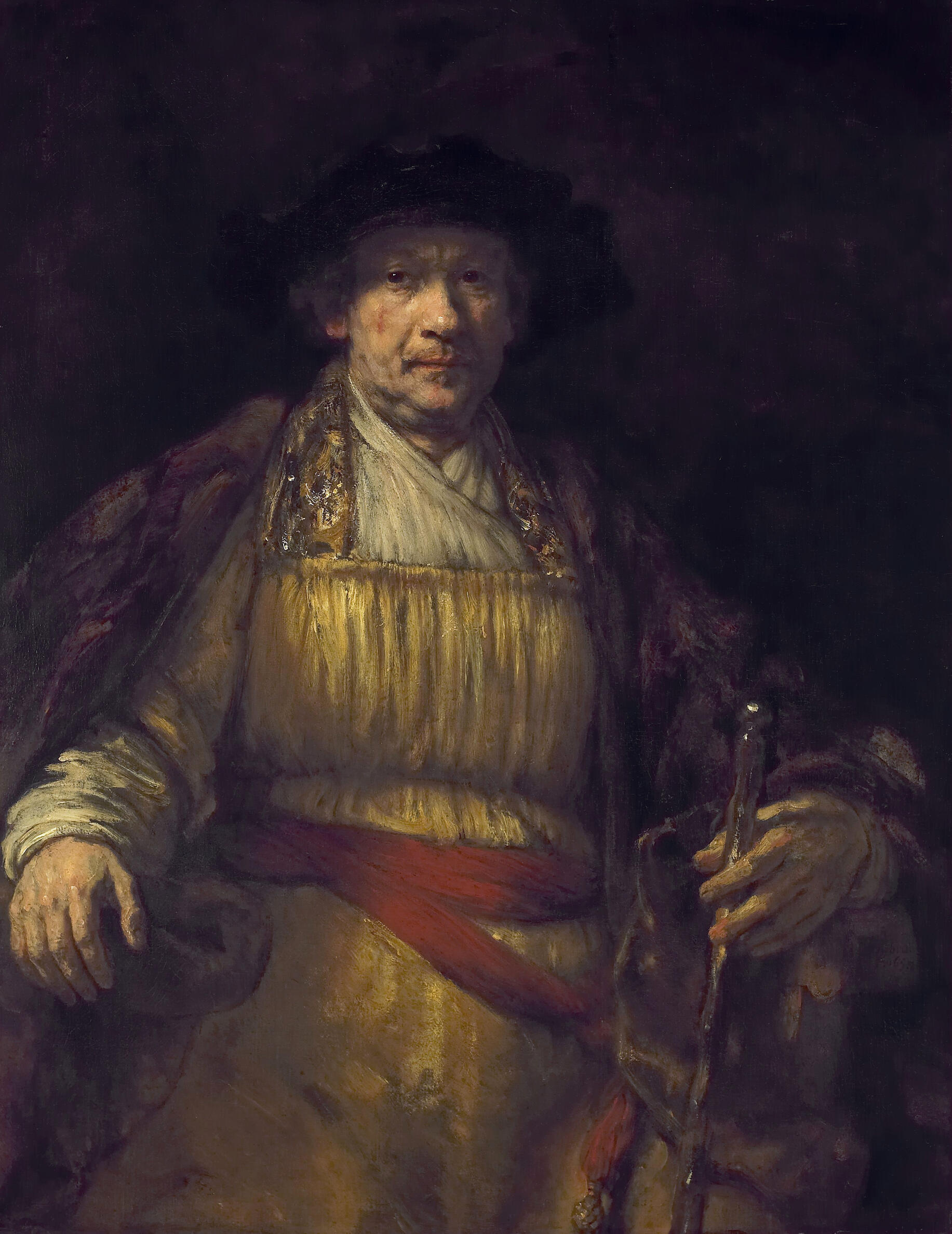
Frick Collection, New York
Rembrandt van Rijn (Dutch, 1606–1669), Self-Portrait, 1658. Oil on canvas, 52 5/8 x 40 7/8 in. (133.7 x 103.8 cm)
Weaving the Textiles
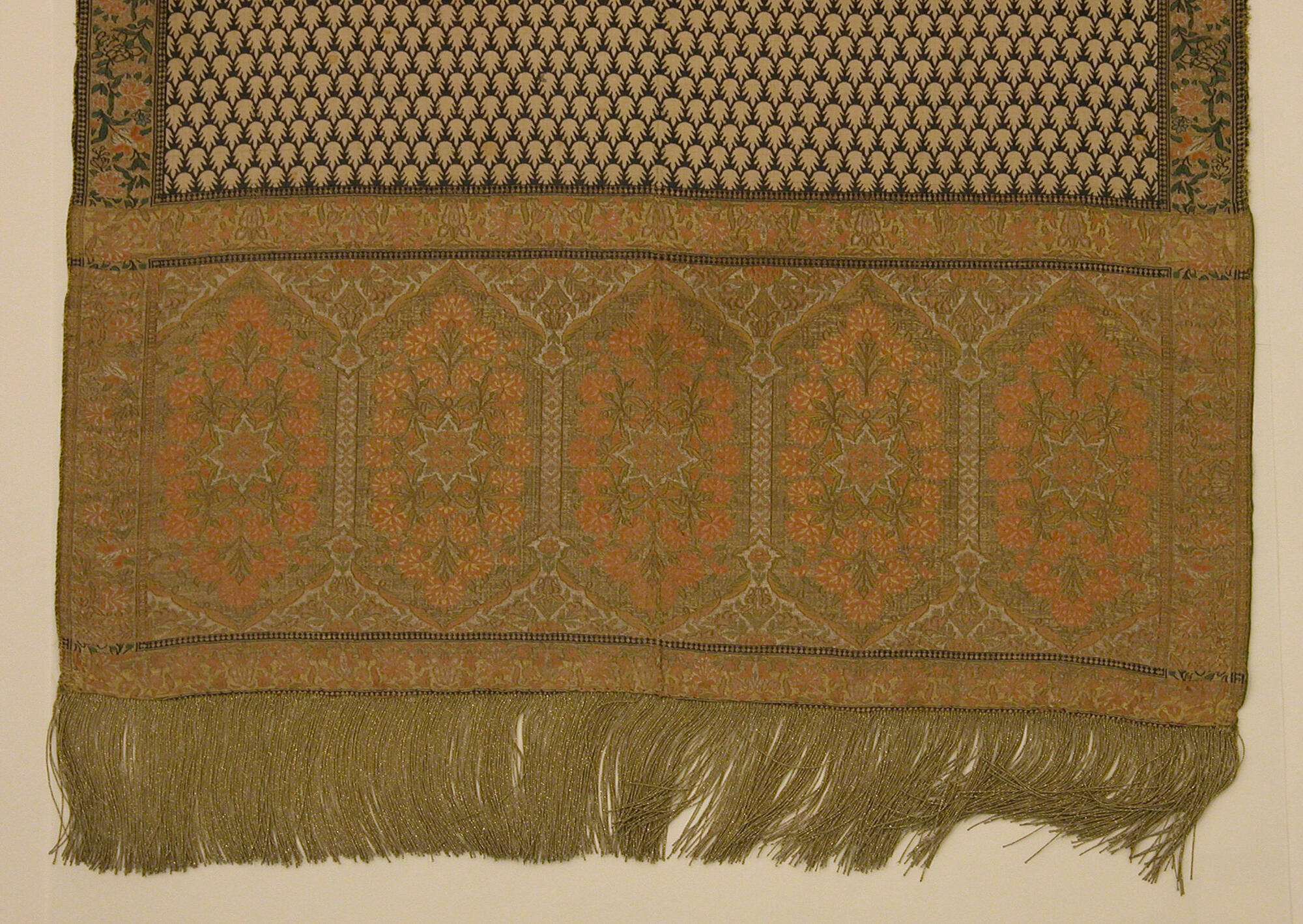
In technical terms, sash and turban fabrics were generally woven to the maximum width of a loom and could be several yards long. The dimensions are determined by the warp, a series of threads that are measured and held taut on the loom. Once the loom is warped, the weaver adds a second set of threads known as the weft, which is wrapped around a bobbin and passed between the warp threads. To create patterned silks, such as florals, weavers follow a complex numeric sequence that lifts and lowers the warp threads. In textile terms, adding stripes to silks is the simplest patterning, requiring only the addition of colored or metallic threads interspersed in one set of threads (usually the weft). Often the textiles depicted in paintings were small pieces or fragments, and the artists had to visually create the appearance of abundance. Rembrandt’s scarf, therefore, contains enough of that glint of gold to signal an exotic “Eastern” silk while also being an affordable item for the young painter to keep in his studio.
The Metropolitan Museum of Art, New York (11.58.1)
Attributed to Iran, Sash (detail), 17th century. Silk, metal thread, 182 x 23 3/4 in. (462.3 x 60.3 cm)
The Opulence of Faraway Lands
Mastering the haptic qualities of textiles was critical to the success of painters in this period. In addition to expressing in detail the quality of luxury silks worn by sitters, the golden weft threads of Persian and Turkish silks evoked the opulence of faraway lands ruled by rich kings, such as in the time of Esther.
Upon moving to Amsterdam in 1633, Rembrandt was accepted into the Guild of Saint Luke, set up a workshop, and mentored young nobility who paid annual fees to learn from his mastery. He produced over eighty self-portraits throughout his life, as well as commissioned portraits showcasing exotic goods available in Amsterdam’s marketplace. These portraits became known in Dutch as Turckse tronies, an image type popularized by Rembrandt and Lievens, meant to evoke a non-specific “Oriental” type characterized by sashes, turbans, and other exotica.
Ultimately, Rembrandt’s inclusion of the metal-thread striped scarf in his early self-portrait may have paved the path for his expertise in recreating these silks in his mature works, adding the glint of gold representing the exotic east.
Selected References
Floor, Willem M. "DUTCH-PERSIAN RELATIONS." Encyclopaedia Iranica. Published December 15, 1996. https://doi.org/10.1163/2330-4804_EIRO_COM_8603 Accessed 26 May, 2026.
Schwartz, Gary. “Convention and Uniqueness in Rembrandt’s Response to the East.” (2020)
https://www.garyschwartzarthistorian.nl/convention-and-uniqueness-in-re…
Swan, Claudia. “Lost in Translation: Exoticism in Early Modern Holland.” In The Fascination of Persia, edited by Axel Langer. Zurich: Museum Rietberg and Verlag Scheideggar & Spiess AG, 2013: 100–117.<
Further Reading
Mayor, A. Hyatt. Rembrandt and the Bible. New York: Metropolitan Museum of Art, 1979.
Munroe, Nazanin Hedayat. “The Patterns of Poetry,” Hali Magazine, Summer 2025 (June/July)
Munroe, Nazanin Hedayat. “Figural Silk in Safavid Iran,” Khamseen: Islamic Art History Online, published 23 January 2025.
Zell, Michael. "Rembrandt’s Gifts: A Case Study of Actor-Network-Theory," Journal of Historians of Netherlandish Art 3:2 (Summer 2011) https://doi.org/10.5092/jhna.2011.3.2.2
You May Also Like

Read More on the Blog
Esther a Biblical Heroine

Learn about the Exhibition
The Book of Esther in the Age of Rembrandt

Buy A Book