Their Travels
I love to get off of a plane at a place and [not] understand the language you're speaking…sometimes you would just right away be in an entirely different situation.
Isabella Stewart Gardner's World Travels
Isabella Stewart Gardner began traveling the world to heal from the death of her and her husband Jack’s twenty-month-old son Jackie in 1865. About two years after Jackie’s death, the couple set sail for Scandinavia, Central Europe, and Russia. This was the first of what would be many international trips that would ultimately take them to more than thirty-nine countries (based on present day borders).
Gardner was an intrepid traveler who moved across continents and countries by train, boat, and on foot. Thanks to their wealth, she and Jack traveled for months at a time, unencumbered by budgets or schedules—their primary source of income came from investment assets like real estate and shares of industrial companies. Their journeys included a year-long trip around the world from 1883 to 1884 that took them throughout East and South Asia—including extensive stays in China, Japan, and India—and culminated with a month spent in Europe, primarily in the Italian city of Venice. During that trip, she likely became one of the first American women to visit the temple complex of Angkor Wat in Cambodia—a visit facilitated by French colonial infrastructure.
Gardner did not purchase major works of art on her trips, and the journeys mostly took place before she and Jack became serious art collectors. Instead, she gathered small souvenirs and recorded her impressions in collaged travel albums, which include pressed botanicals, found papers, and a range of landscape, architectural, and ethnographic photographs from the nineteenth-century tourist trade. One of these albums is on display here, and eight more are on display in the exhibition Fellow Wanderer: Isabella Stewart Gardner’s Travel Albums in the Fenway Gallery in the Palace.
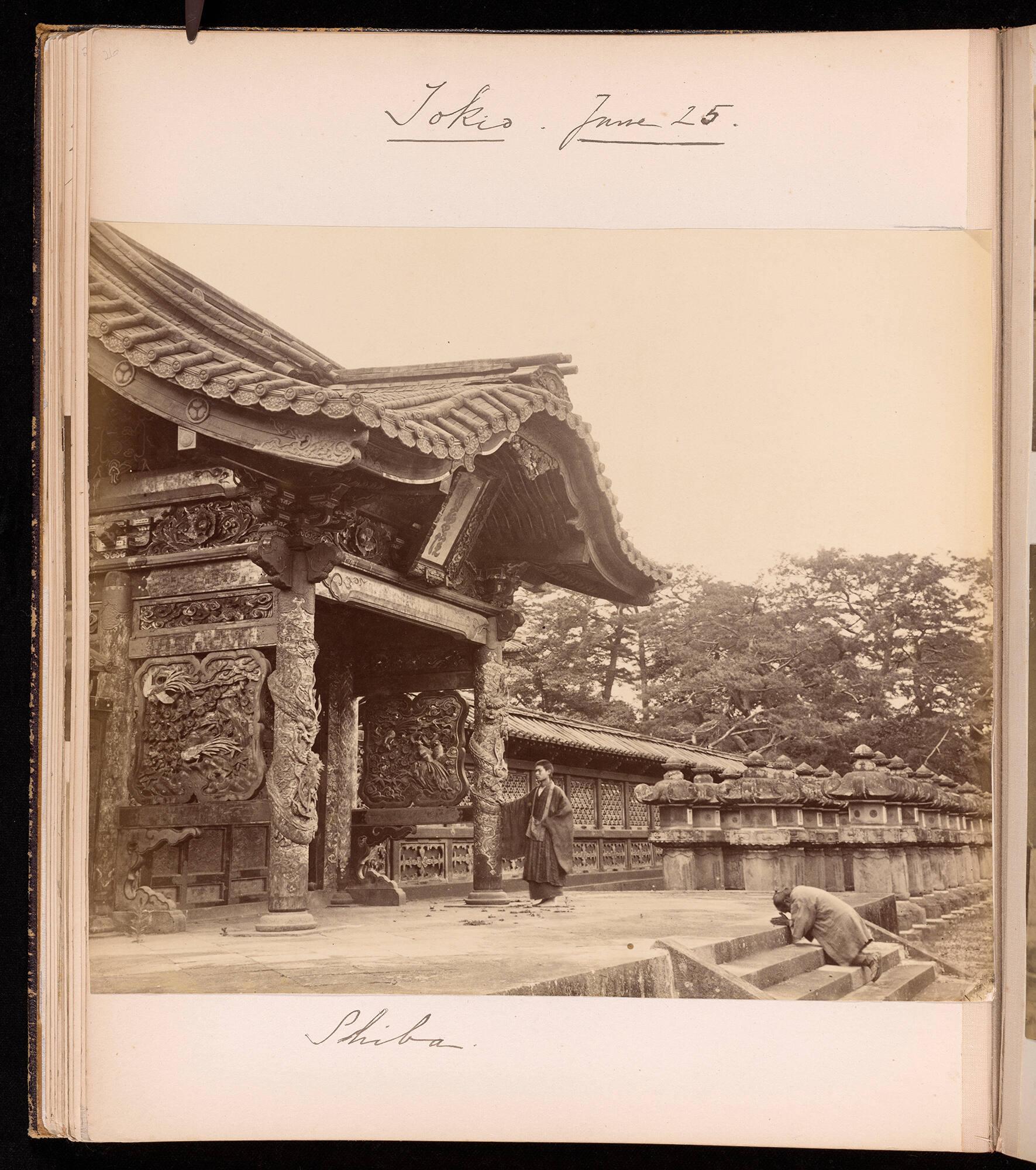
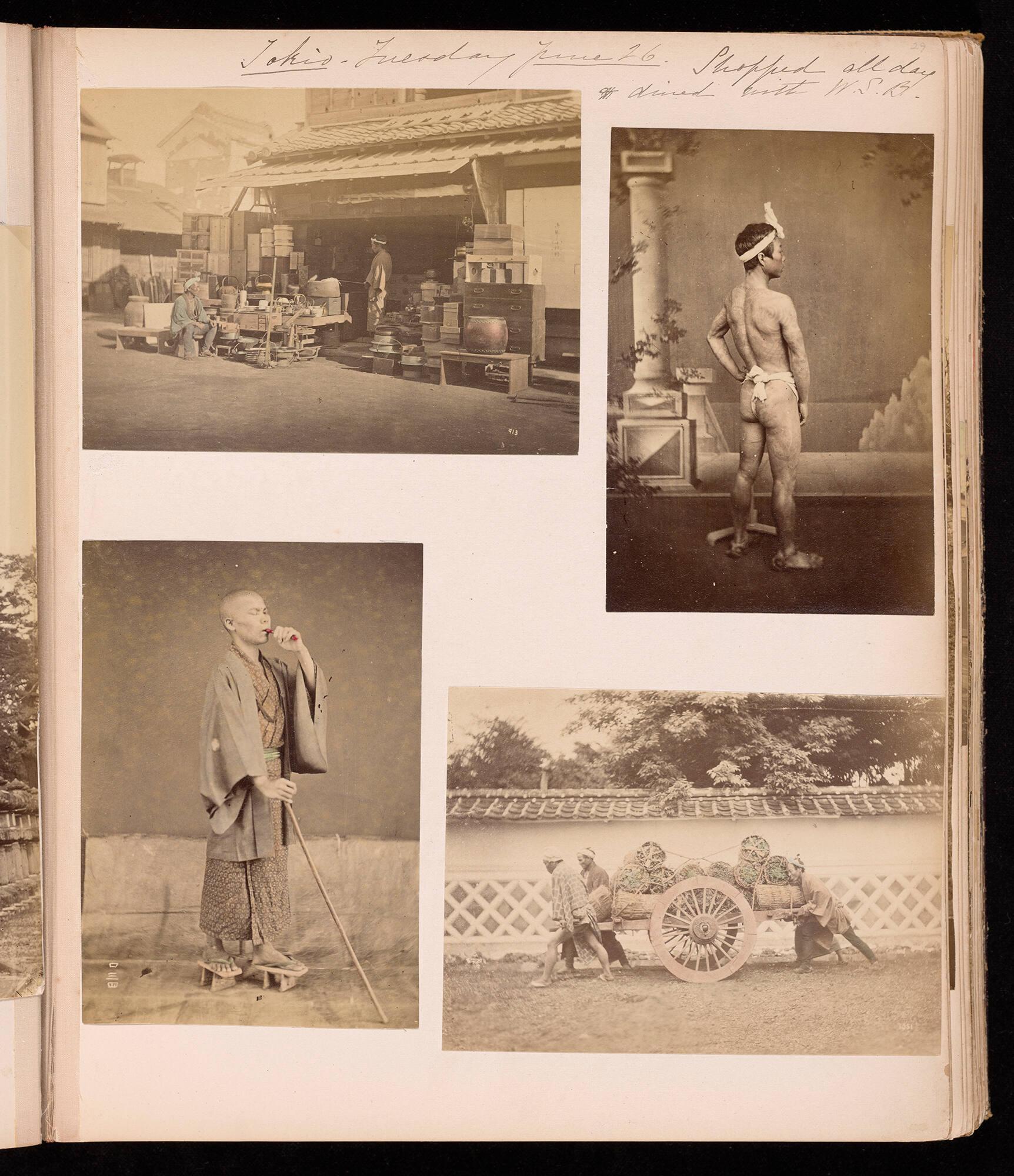
Gardner and her husband visited Japan in 1883, where they traveled for months along already-well-worn tourist pathways. Japan had a long history of domestic tourism, and by the 1870s European and American travelers—referred to as “globetrotters” by Japanese people—were a common sight along these routes. Photographs like the ones Gardner purchased and pasted in this album were part of the Japanese tourist experience, both for domestic and international visitors.
Many photographers active in nineteenth-century Japan were European and specifically created images catering to foreign tourists’ conceptions of Japan as an exotic space. Spreads like this one show typical subjects, including a temple and a tattooed laborer. A close examination reveals that many of the tattoos were in fact painted on the photograph after the fact. This is unsurprising given that tattoos were outlawed for Japanese citizens in 1872.
Betye Saar’s World Travels
Betye Saar started to travel widely in her forties, once she felt that her three daughters—then adolescents—were old enough to spend stretches of time without her. For many years Saar’s travel destinations were, in large part, a function of the funding available for her trips. She received arts fellowships and awards to travel to certain countries, such as Haiti in 1974, and applied to artists’ residencies in foreign locations that interested her. These programs provided both inspiration and income. In the last thirty years she has supplemented these professional trips with personal ones as an interested tourist, such as a long-desired trip to Egypt with family and friends in 2000. To date, she has visited thirty-two countries.
Regardless of where she is traveling, Saar has always sought out what she describes as alternative environments, such as a popular local shrine or someone’s “funny little yard.” Saar records her trips and experiences in sketchbooks and scrapbooks combining found paper, pressed botanicals, and vivid watercolors.
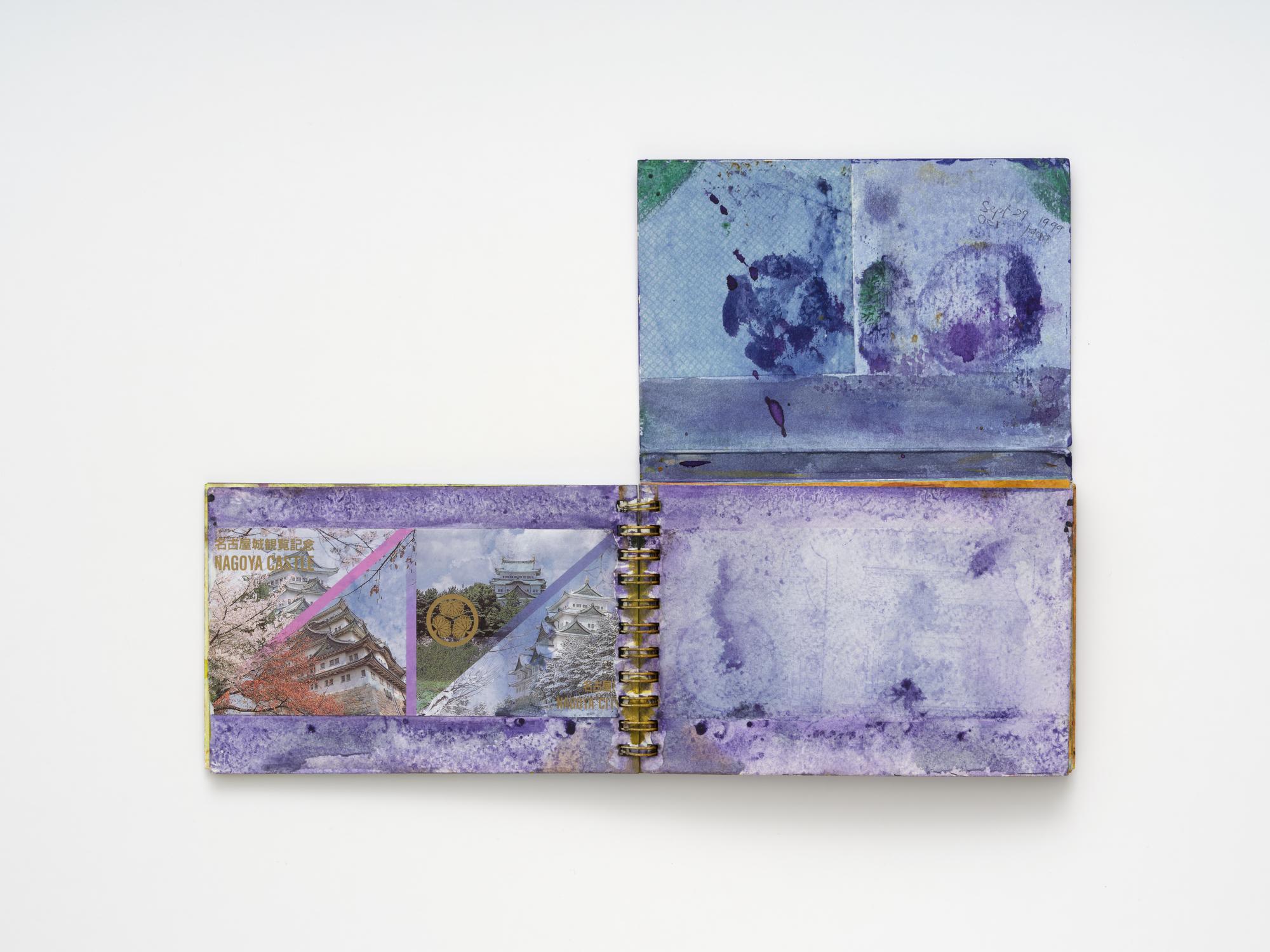
Betye Saar, Japan Sketchbook, PAGES 6-7, 1999
Watercolor and found paper
Two pages of a spiral sketchbook are oriented horizontally. Both are irregularly painted with purple watercolor. The pages oppose each other in the open notebook with the vertical spiral spine between them. The left page shows views of Nagoya Castle, a tall, white, five story Japanese building with sweeping triangular gables on each of the stacked floors. These commercial photographs of the castle are pasted onto the center of the page. The photographs are composed as squares divided diagonally by pink or purple borders into triangular shaped views of the castle and its surrounding landscape. One square is labeled Nagoya Castle in gold on the top left in both English and Japanese. The other square has a gold circle containing three palm leaves motifs and a line of Japanese characters printed in gold. The page of the sketchbook on the right side is irregularly stained with pale purple watercolor. It has a faint impression of the outline of the photographs on the other side. There is a third sketchbook page positioned above the one on the right side. It shows two equal size squares at the top painted in purple or blue watercolor, each with an irregular, painted, green corner. There is a roundish blotchy shape in each square. The one on the right side also has handwritten dates in pencil: "Sept 29 1999 and Oct 1999." There are two long thin rectangles below the squares faintly painted in different hues of purple.
Saar draws, paints, and creates collages in her sketchbooks while she is traveling, but she will often continue to work on the drawings once she is back in her Los Angeles studio. There she applies additional washes of watercolor. She created this sketchbook during her 1999 trip to Japan, and included this snapshot of her standing in front of a palace in Nagoya. Like Gardner before her, she participated in the historic tradition of Japanese tourism that included a path of picturesque sites long visited by both domestic and international travelers.