
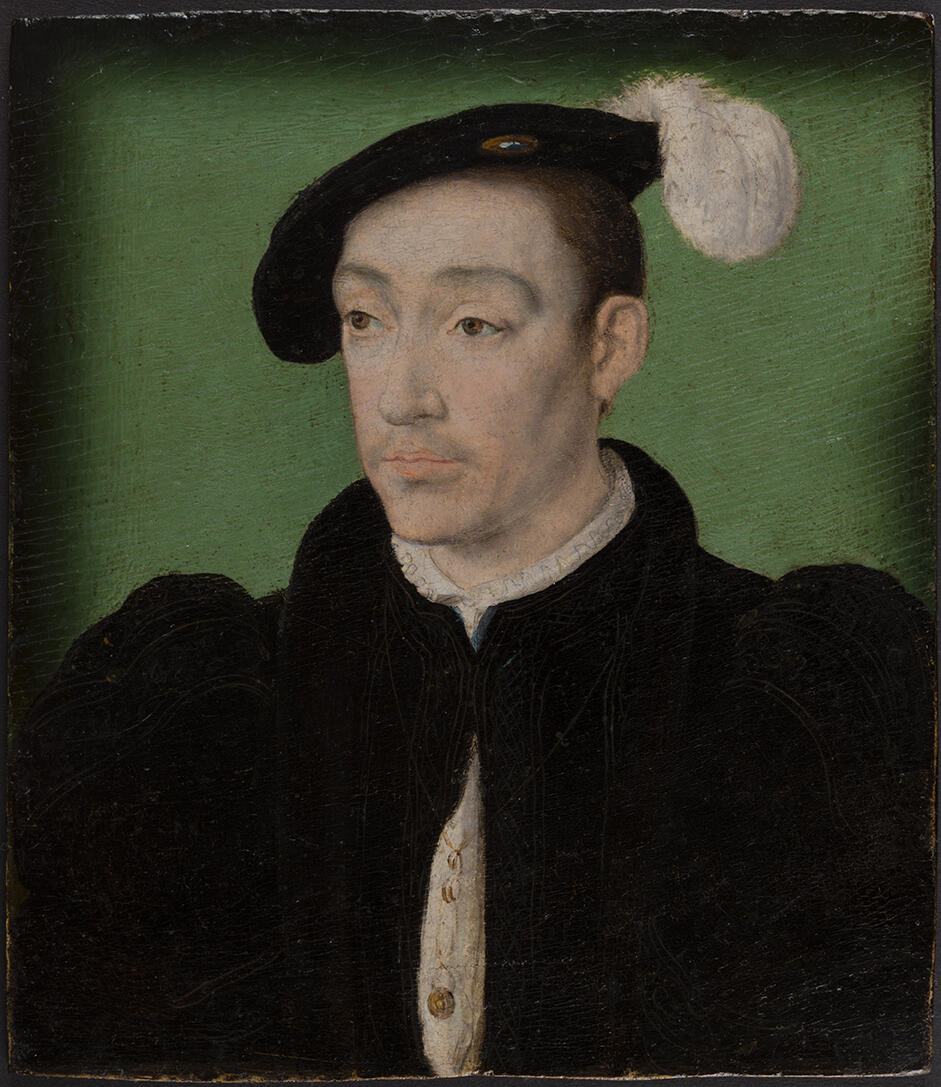
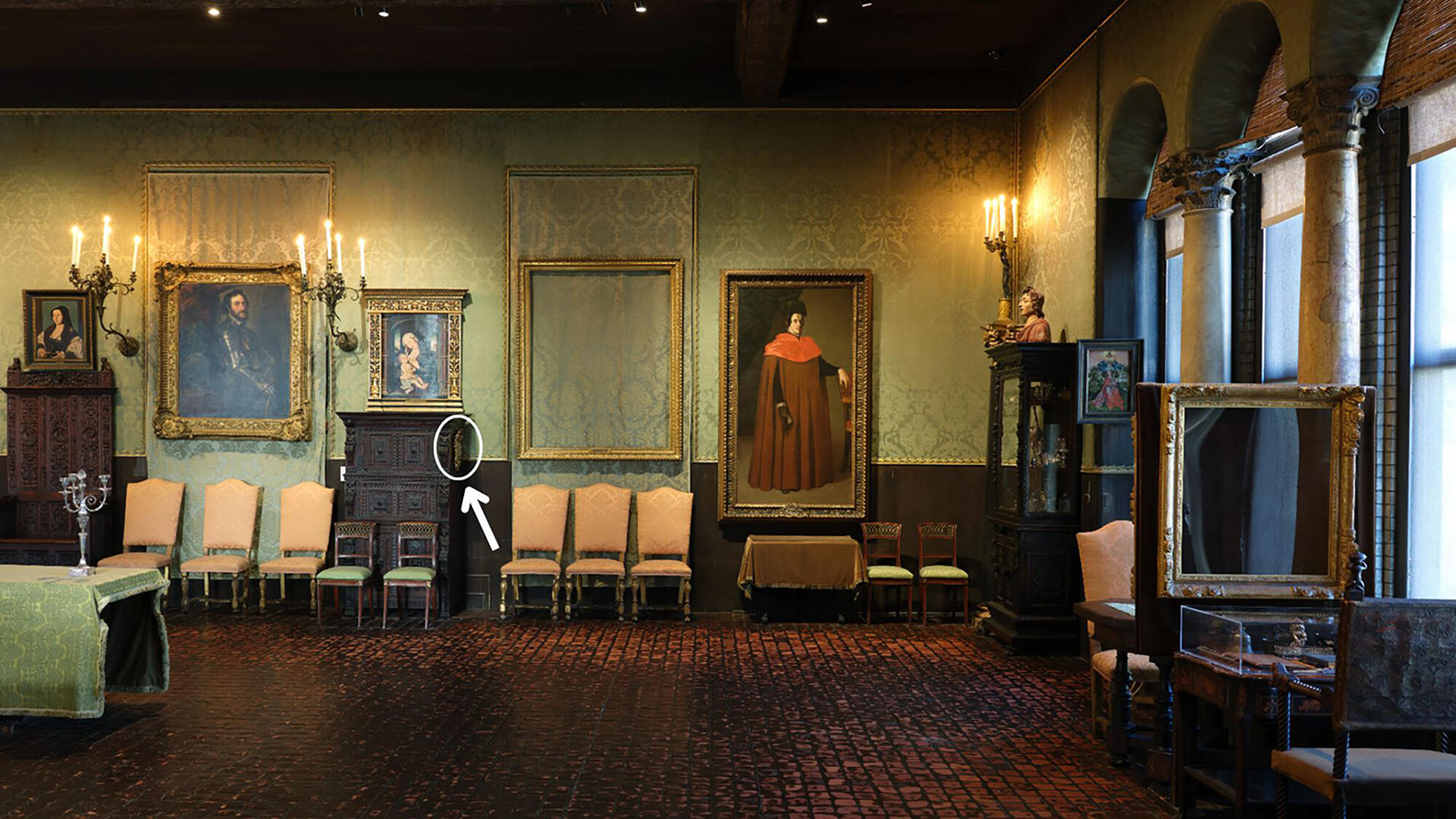
Isabella Stewart Gardner displayed a small portrait of a prince on the side of a walnut cabinet in the Dutch Room. Conservation staff had the opportunity to examine and clean this small painting as part of the Dutch Room Restoration in 2026.
The Doomed Prince
The subject of the portrait is François, Dauphin of France (1518–1536), the heir to the French throne and the first son of King François I and Claude de Valois. At the tender age of eight, the Dauphin and his younger brother were held hostage as part of a power struggle for European dominance by the Holy Roman Emperor, Charles V after his father’s defeat at the Battle of Pavia. After three years in captivity, the boys returned to France emotionally scarred from their experience. The Dauphin became increasingly isolated and preferred to wear black clothing, in contrast to the typical colorful fashion of the French court at the time.
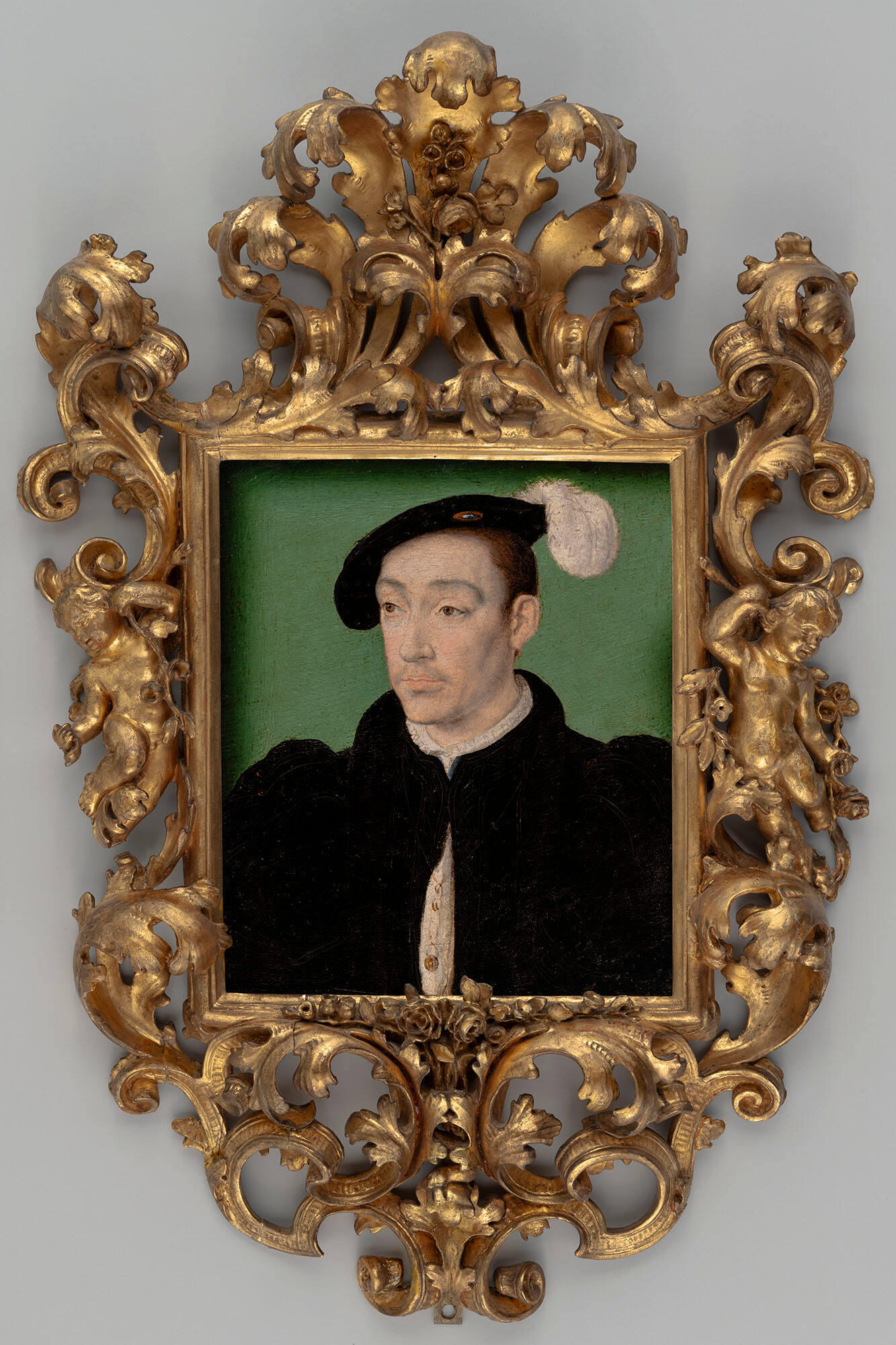
Isabella Stewart Gardner Museum, Boston (P21s23)
After Corneille de Lyon (Netherlandish, 1500–1510—1575), The Dauphin François, about 1536. Oil on panel, 16 x 14 cm (6 5/16 x 5 1/2 in.)
Shortly after turning eighteen, the Dauphin’s story came to an abrupt and unusual end—while playing tennis. After drinking a cup of water brought to him by Count Montecuccoli, the Dauphin collapsed. In truth, he likely died of tuberculosis or pleurisy, but the Count was accused of poisoning him and was executed.
The Artist: Corneille de Lyon
The Dauphin’s portrait is one of four known versions attributed to the artist Corneille de Lyon and his studio. Little is known about the early life or training of Corneille who is likely from The Hague in the Netherlands. His work is first documented in Lyon, France, hence his name. He painted portraits of both everyday members of society and members of the French royal court.
Corneille de Lyon’s paintings usually have similar compositions. Most portraits are half length and are painted on small wooden panels. The backgrounds are typically a bright blue or green with shadows painted along the edge. He likely had assistants working in his studio, who mixed oil and pigments to make paint and prepared the wooden supports.
The Painting
The Gardner portrait follows the characteristic format of Corneille’s paintings: a half-length portrait with a bright green background with shadowed edges. The small size suggests the painting was meant for intimate viewing.
The Dauphin is depicted in his characteristic black clothing. He is wearing a dark doublet, or snug jacket, over a white linen shirt with a ruffled collar, a gold chained medallion, and a dark hat with another medallion and a white feather. The artist thinly applied the layers of paint to delicately create the prince’s face with careful brushstrokes.
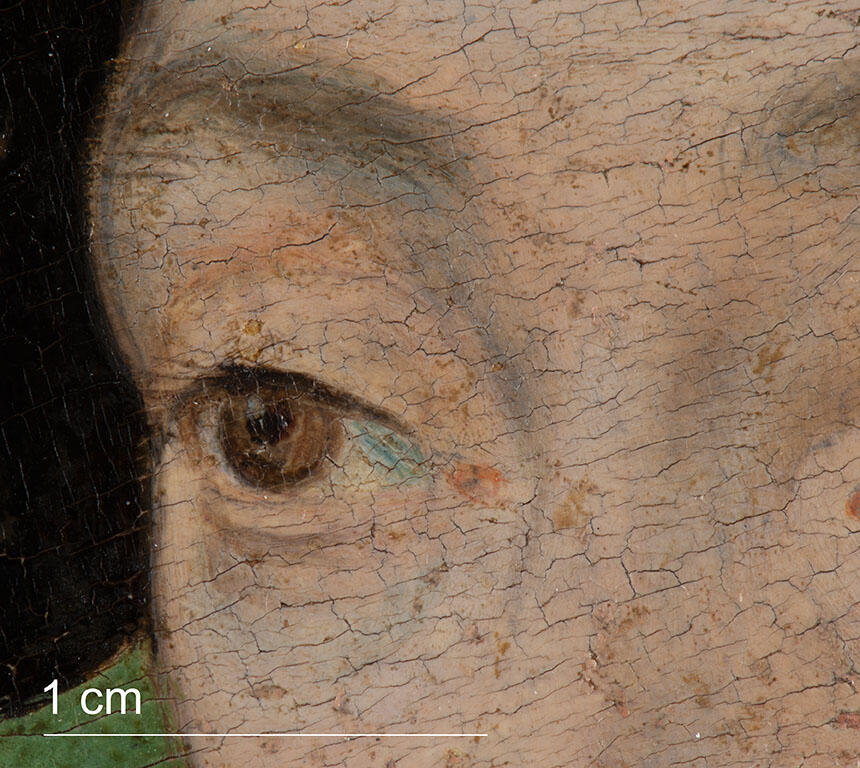
Detail, photomicrograph of the Dauphin’s right eye after cleaning
The Conservation Treatment
The small painting had not been cleaned since the early 1900s. The painting’s natural resin varnish layer had discolored from clear to a warm yellow over time. Varnishes are protective coatings applied to paintings to saturate the paint and to protect the surface from grime and debris.
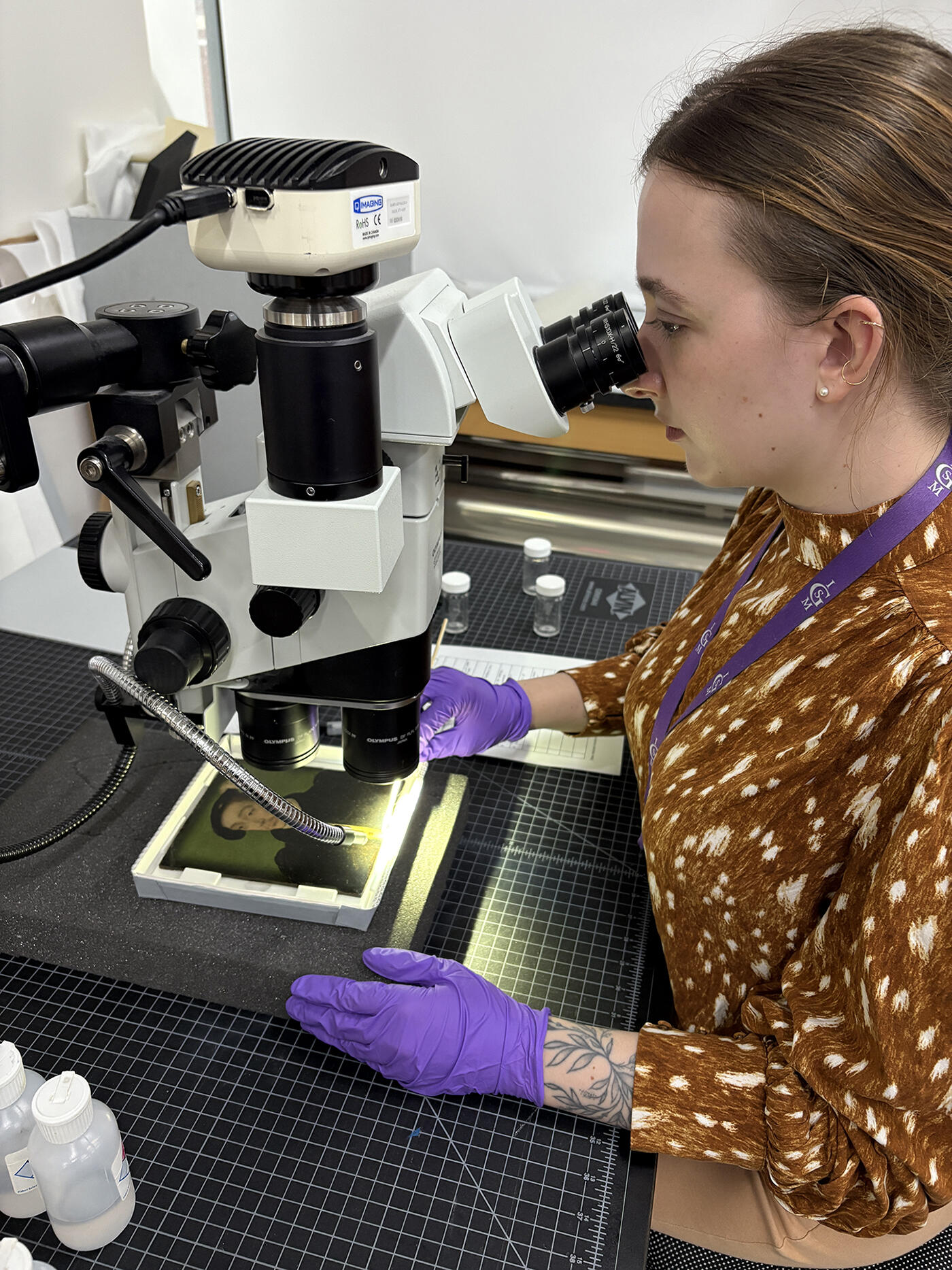
Isabella Stewart Gardner Museum, Boston
Kelsey Marino, Graduate Paintings Conservation Intern, examining the Dauphin’s portrait under the stereomicroscope
After careful testing, I reduced the discolored varnish under the microscope using solvents and a specialized gel. It was satisfying to watch the beautiful original colors slowly return as the old varnish disappeared.
Once cleaned, I reapplied a more reversible synthetic varnish that replicates the sheen and saturation of a natural resin varnish. I retouched areas of loss with conservation-grade media that can be removed without disturbing the original paint. Now the vibrant green and delicate brushstrokes of the painting edges can be fully appreciated.
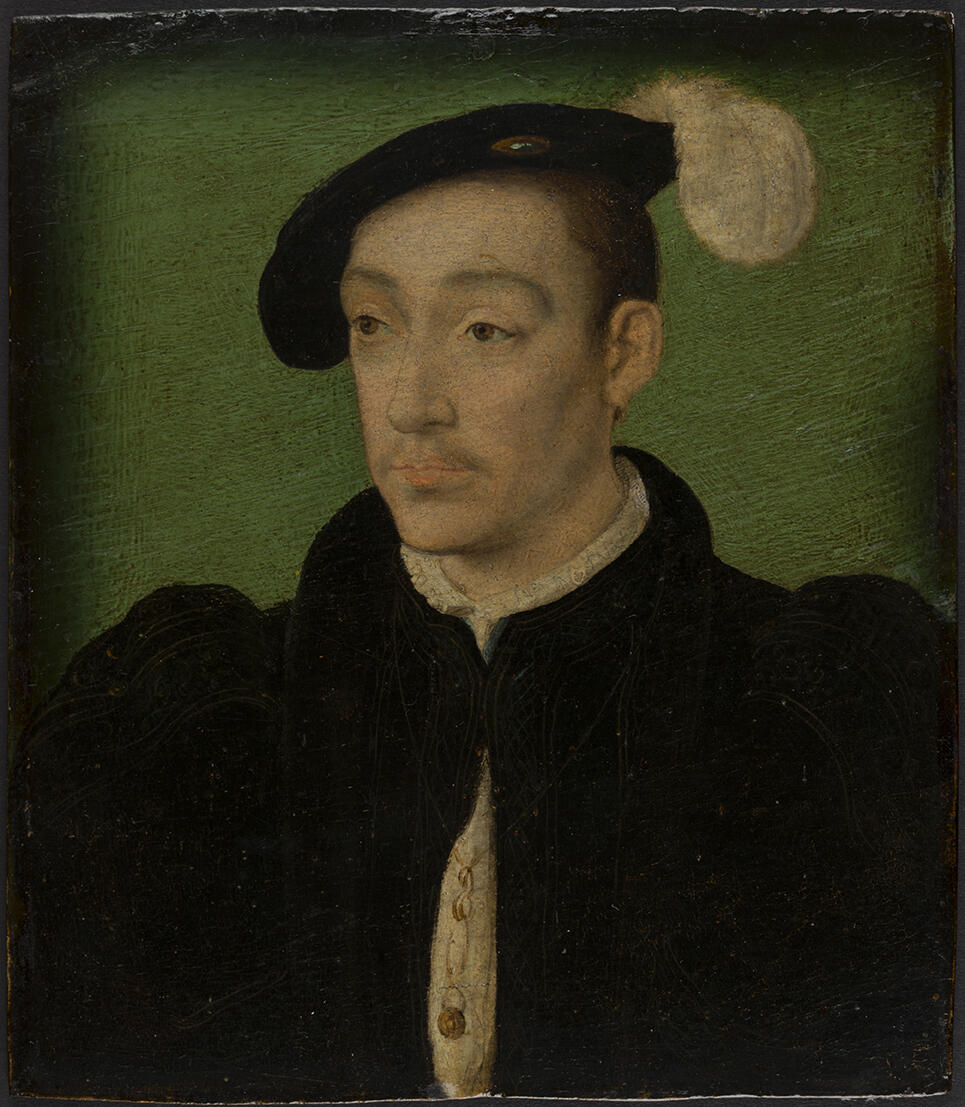
The painting, The Dauphin François, before (left) and after (right) cleaning and conservation treatment
The Question of Copies and Further Research
We don’t know why the four versions of the portrait were commissioned. Were they a bulk order to send to potential suitors for the Dauphin? Although the Dauphin was previously engaged to Mary Tudor, whose portrait also hangs in the Dutch Room, he was an eligible bachelor at the time of his death. Were the paintings created after his untimely death to memorialize him? Cleaning the painting also allowed us the opportunity to conduct technical analysis and collaborate with the other holding institutions in the hopes of answering some of these questions.
Currently the underdrawings from three of these paintings are being compared using infrared reflectography imaging. This technique can reveal carbon-based underdrawings beneath visible paint layers which can illuminate workshop practices and be used to distinguish different artist hands. Underdrawings that appear identical may indicate the paintings were created at the same time. On the other hand, visually different underdrawings suggest the paintings were not executed at the same time or perhaps by the same hand.
Additionally, conservators are also investigating the materials used to create Corneille’s characteristic green background. These future discoveries may shed light onto Corneille’s studio practices and may explain why multiple paintings of the prince were created.
Isabella Stewart Gardner Museum, Boston
View of the south wall of the Dutch Room with the location of The Dauphin François D'Angouleme circled in white
After the Dutch Room Restoration project is completed at the end of 2026, visitors may see the newly cleaned portrait on the side of the cabinet in front of the empty frame for Rembrant’s Christ in The Storm on the Sea of Galilee. The refreshed green textiles on the nearby wall will surely compliment the painting's vibrant green background.
You May Also Like

Read More on the Blog
Explore the Dutch Room Restoration

Read More on the Blog
Reupholstering the Dutch Room Chairs

Read More on the Blog